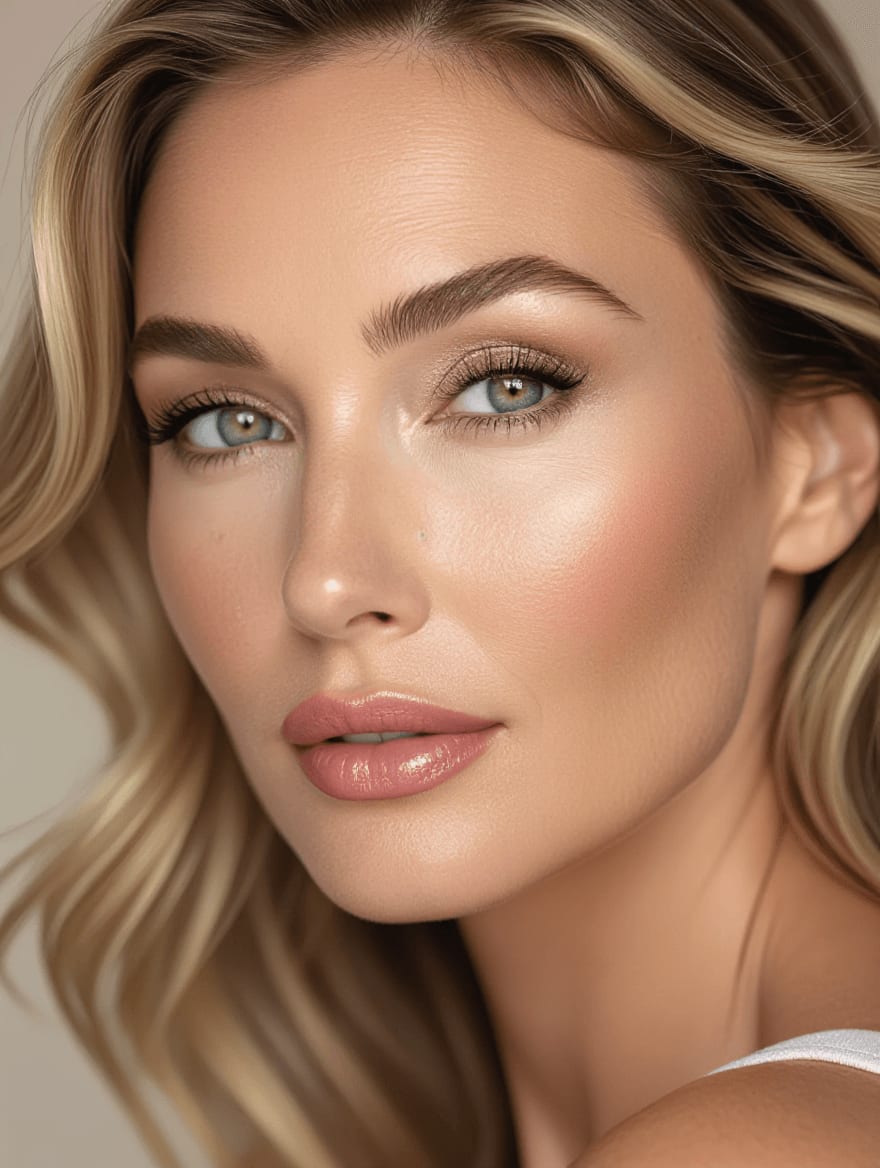
Why Your Old Eye Makeup Techniques Stop Working After 40
The eyelid changes during perimenopause and menopause aren't just about wrinkles. Declining estrogen reduces collagen production by up to 30% in the first five years after menopause, causing the delicate eyelid skin to lose elasticity and develop a crepey texture. Fat pads above the eyes shift downward, creating hooding that wasn't there before. Oil production drops, making powder formulas cling to dry patches you never noticed in your 30s.
What works: Cream eyeshadows and liquid formulas glide over texture without emphasizing it, while powder shadows require primer and strategic placement to avoid settling into creases. The menopausal shift in skin pH also affects how makeup adheres—what used to stay put for 8 hours may now migrate within 3. Understanding these physiological changes, which connect to broader makeup adjustments during menopause, explains why technique matters more than product quantity.
The Hooded Lid Reality
About 60% of women develop some degree of eyelid hooding by their mid-40s, yet most makeup tutorials ignore this reality. Traditional crease work becomes invisible when you open your eyes—the makeup literally disappears under the hood. The solution isn't more eyeshadow; it's placing color above where your natural crease has migrated. Look straight ahead into a mirror. Where you see the fold when your eyes are open—that's your new placement zone, typically 2-3mm higher than your anatomical crease.
Beginners often make the mistake of applying eyeshadow with their eyes closed, following the natural crease. When they open their eyes, the entire gradient has vanished. Experienced practitioners apply transition shades with eyes open, checking visibility at every step. This technique shift is more impactful than any product upgrade.
Common Myths vs. What Actually Works
Myth 1: Avoid Shimmer Completely
The truth: Large glitter particles and chunky shimmers do emphasize texture, but finely-milled pearl finishes actually reflect light away from fine lines rather than drawing attention to them. Completely matte eyes can appear flat and aged on mature skin. The key is particle size—look for words like "satin," "luminous," or "silk" rather than "glitter" or "metallic." Apply pearl finishes to the inner corner and center of the mobile lid, avoiding the outer corner where crow's feet are most prominent.
Myth 2: Dark Eyeshadow Makes You Look Older
This advice assumes dark shades are applied the same way as in your 20s. Deep shades along the upper lash line actually create definition that thins with age, making eyes appear more awake. The mistake is dragging dark colors up into the crease on hooded lids, which creates a heavy, drooping effect. Instead, keep deep shades as a thin line pressed into the upper lash line with a small, dense brush—this restores the contrast your eyes had naturally before perimenopause thinned your lashes and lightened your lash line.
The Primer Paradox
Everyone recommends eyeshadow primer for mature eyes, yet it often worsens creasing. Why? Most primers are designed for oily, young eyelids. On dry, menopausal skin that's already struggling with sensitivity and moisture retention, they create a tacky base that grabs powder particles unevenly. The better solution: a thin layer of eye cream allowed to absorb for 3-5 minutes, followed by a dusting of translucent powder. This creates a smooth canvas without the grip that emphasizes texture. For very oily lids (rare but possible in perimenopause), a mattifying primer still works—know your specific skin, not the general rule.
Application Techniques That Actually Account for Aging Eyes
The Minimal vs. Glam Decision Point
For natural, minimal eye makeup that enhances without obvious color: Use a single cream shadow in a neutral tone one shade deeper than your skin, applied with your finger from lash line to brow bone, blending upward. Add definition by pressing a deeper shade (taupe, soft brown) into the upper lash line with a pencil brush. Finish with brown mascara on upper lashes only. Total time: 90 seconds. This approach works particularly well for daily wear when you want to look polished without "makeup-y."
For elevated or glam eye makeup that photographs well and holds up for events: Layer a cream base under powder shadows to prevent fading. Apply your darkest shade with eyes open, placing color where you want depth to appear—usually the outer third of the lid, blended upward and outward. The critical difference after 40: blend with a clean, fluffy brush after initial placement, using circular motions in the transition zone. Young eyes can skip this step; mature eyes need it to avoid harsh lines that emphasize texture changes.
The Lash Line Strategy
Lower lash line application changes significantly after 40. Harsh lines and dark colors applied directly to the waterline or lower lash line can drag down eyes that are already experiencing tissue descent. Instead, use a smudge brush to apply a soft taupe or gray-brown shadow along the outer two-thirds of the lower lash line only, stopping before the inner corner. This creates definition without the aging effect of a full lower rim of dark color. Many women in their 40s discover they look more awake by skipping lower liner entirely and using a flesh-toned pencil on the waterline to brighten.
When Standard Advice Fails: The Deep-Set Eye Exception
Most eye makeup advice for women over 40 assumes eyes are becoming more hooded and prominent. But women with naturally deep-set eyes experience the opposite problem—their eyes recede further into the socket with age, creating a shadowed, tired appearance. For deep-set eyes, the standard "place color above the crease" advice makes things worse. Instead, concentrate lighter, reflective shades on the entire lid and use darker shades sparingly along the actual crease to prevent it from appearing even deeper. This is a case where shimmer on the entire lid is beneficial, and heavy brow bone highlighting (recommended elsewhere) should be avoided as it increases the depth illusion.
- Trade-off to understand: Long-wearing, budge-proof formulas often contain more film-formers and silicones that can emphasize dry texture. If your lids are extremely dry, you may need to choose between longevity and appearance, opting for shorter-wearing but more emollient formulas.
- Real experience signal: Women in early perimenopause (ages 40-45) often still have enough lid elasticity for traditional techniques. The dramatic shift typically occurs 2-3 years into perimenopause when estrogen fluctuations become more severe. You may need to revisit your technique every 1-2 years rather than assuming one method works for the entire decade.