
Understanding Frozen Shoulder During Menopause: The Hormonal Mechanism
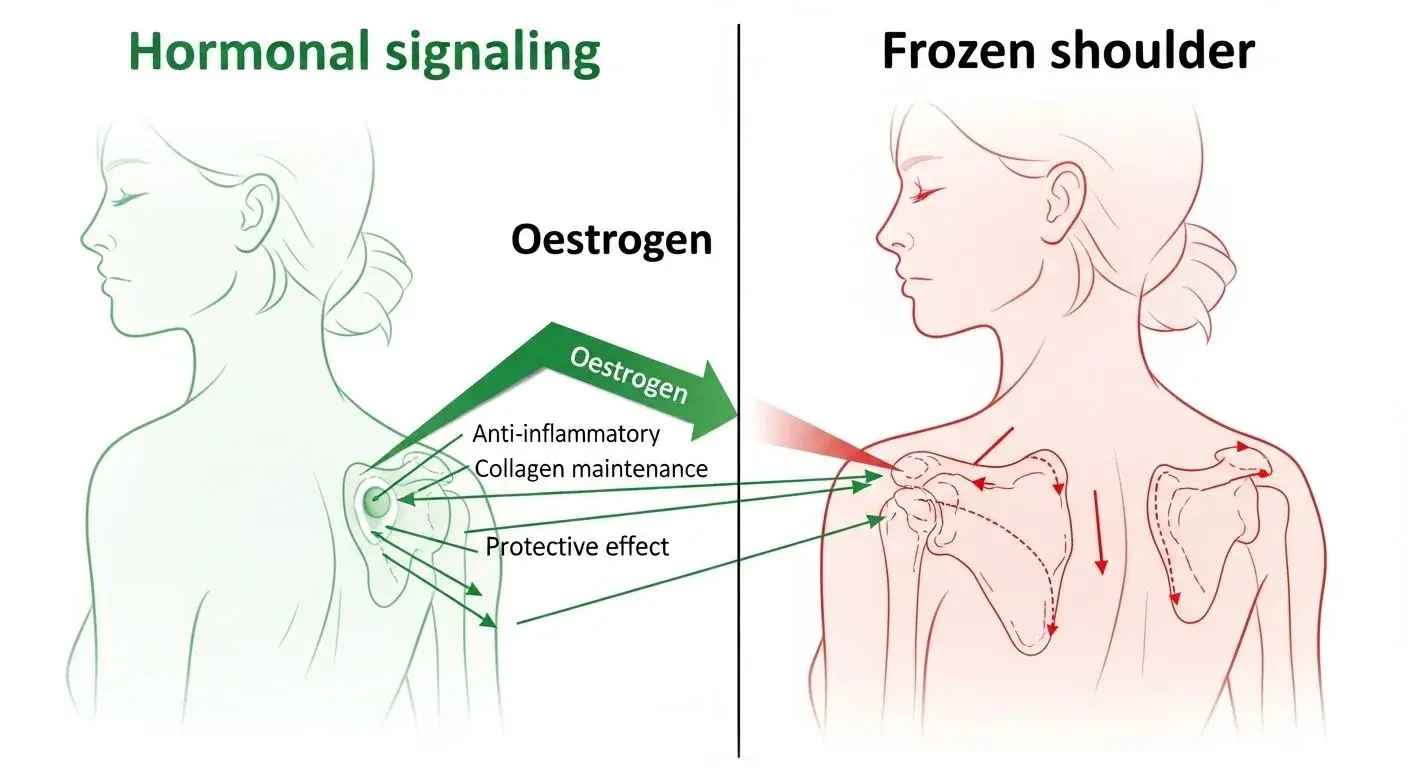
Frozen shoulder — clinically known as adhesive capsulitis — is not simply a mechanical problem that happens to strike women in their 40s and 50s. Research now shows that the condition is directly linked to oestrogen decline, which is why women are affected at twice the rate of men and why the peak incidence of frozen shoulder overlaps almost precisely with the perimenopausal transition.
Oestrogen receptors have been identified in the tissue of the shoulder capsule — the fibrous sleeve surrounding the glenohumeral joint. When oestrogen levels fall, this tissue loses an essential regulatory signal that controls inflammation and connective tissue remodelling. The result is a fibrotic cascade: the capsule becomes inflamed, contracts, and progressively restricts shoulder movement through three distinct stages — freezing (painful), frozen (stiff), and thawing (recovering).
Beyond the capsule itself, oestrogen decline also reduces joint lubrication, increases pain sensitivity at the nerve endings within the shoulder, and undermines the immune regulation that normally resolves inflammation efficiently. This combination creates the perfect biological conditions for frozen shoulder to develop — and to persist longer than it might in younger, pre-menopausal women. Perimenopause body aches and muscle and joint pain are well-documented manifestations of the same underlying hormonal shift.
Common Myths About Menopause and Shoulder Pain — vs. What the Evidence Shows
Several misconceptions persist about frozen shoulder and its relationship to menopause. Getting these wrong leads to delayed diagnosis, inadequate treatment, and unnecessary suffering.
- Myth: 'Shoulder pain in menopause is just muscle tension from stress': While stress and elevated cortisol do contribute to musculoskeletal tension, frozen shoulder involves structural capsular changes that require targeted treatment — not relaxation alone. Delaying diagnosis by months while treating it as 'just stress' allows the fibrotic process to deepen.
- Myth: 'It will resolve on its own — just wait': While most cases do eventually improve, up to 40 percent of patients report residual pain and restricted function at 3 years without treatment. Early intervention — particularly corticosteroid injection combined with physiotherapy — significantly shortens recovery.
- Myth: 'HRT does not affect shoulder conditions': This is contradicted by the discovery of oestrogen receptors in the shoulder capsule. There is growing clinical evidence that HRT reduces both the incidence and severity of frozen shoulder in menopausal women.
- What actually works: the combination approach: The most effective management for menopausal women with frozen shoulder combines hormonal treatment (HRT assessment), anti-inflammatory intervention (corticosteroid injection or hydrodilatation), and staged physiotherapy — not any of these elements in isolation.

Practical Treatment Strategies for Frozen Shoulder in Menopause
Treatment for frozen shoulder in menopausal women should address three dimensions simultaneously: pain management, capsular mobility, and hormonal support. Here is how each element works and when it applies.
Pain Management: Early Phase
- Corticosteroid injection: Most evidence-backed for the freezing stage. Reduces pain by 50 to 70 percent within 48 to 72 hours, enabling physiotherapy to begin. Best results when performed within the first 3 months.
- Hydrodilatation: Fluid distension of the joint capsule under imaging guidance. Effective for both pain and mobility in the frozen stage. Some patients experience significant improvement after a single procedure.
Physiotherapy: All Stages
- Stage-matched exercise: Pendulum and assisted range-of-motion exercises during the freezing stage; progressive capsular stretching in the frozen stage; rotator cuff strengthening in the thawing stage.
- Heat before stretching: Applying a heat pack for 10 minutes before each session increases collagen extensibility and improves stretch effectiveness. Essential and often overlooked in home programmes.
Hormonal Support: The Missing Piece
- HRT consideration: Oestrogen replacement restores signalling to the shoulder capsule and reduces the inflammatory environment that drives frozen shoulder. Many women report accelerated recovery after starting HRT. Discuss eligibility and risk profile with a menopause specialist.
- Anti-inflammatory nutrition: Omega-3 fatty acids, magnesium, and polyphenol-rich foods support the anti-inflammatory processes that oestrogen normally regulates.
When standard physiotherapy fails to produce improvement after 3 to 6 months, surgery — specifically arthroscopic capsular release — is effective for treatment-resistant cases. This is a last resort but produces excellent outcomes in the right candidates. Symptoms of low oestrogen and hormone imbalance often co-present with frozen shoulder and understanding the full hormonal picture is key to effective treatment.
Frequently Asked Questions
Can menopause cause frozen shoulder?
Yes, menopause can cause frozen shoulder. Oestrogen decline during perimenopause directly affects the shoulder capsule tissue, which contains oestrogen receptors. Women aged 40 to 60 are the most commonly affected group, and the peak incidence of frozen shoulder aligns closely with the perimenopausal transition.
Does HRT help frozen shoulder?
HRT is increasingly believed to help frozen shoulder in menopausal women. Oestrogen replacement restores signalling to shoulder capsule tissue and reduces the inflammatory environment that drives the condition. Formal trials are ongoing, but clinical observation and mechanistic evidence are supportive.
What causes frozen shoulder in menopause?
Frozen shoulder during menopause is caused by oestrogen decline, which removes the hormonal regulation of shoulder capsule tissue. Without adequate oestrogen, the capsule becomes prone to inflammation and fibrosis. Contributing factors include diabetes, thyroid dysfunction, sleep disruption, and prolonged arm immobility — all of which are more common in midlife women.
Is shoulder pain a symptom of menopause?
Yes, shoulder pain is a recognised symptom of perimenopause and menopause. It can range from diffuse joint aching — related to the general anti-inflammatory loss of oestrogen — to specific conditions like frozen shoulder. Any persistent shoulder pain during this life stage warrants medical assessment.
How long does menopause-related frozen shoulder last?
Frozen shoulder typically lasts 1 to 3 years without treatment. With appropriate physiotherapy, anti-inflammatory intervention, and hormonal support, most menopausal women see significant improvement within 6 to 18 months. Starting treatment early in the freezing phase produces the best outcomes.
Sources
- Oestrogen Receptors in Adhesive Capsulitis Tissue. pubmed.ncbi.nlm.nih.gov — PubMed / NIH
- Frozen Shoulder: Causes, Symptoms, and Treatment. mayoclinic.org — Mayo Clinic
- Perimenopause and Musculoskeletal Health. menopausesociety.org — The Menopause Society
- Adhesive Capsulitis: Evidence-Based Treatment Overview. nhs.uk — NHS