
Can Menopause Really Cause Chest Pain and Tightness?
Yes — and this is one of the most under-discussed menopause symptoms, in part because chest pain appropriately triggers concern about heart disease. The two can and do coexist. But for many women in perimenopause and menopause, chest discomfort, pressure, and tightness are directly hormone-driven and not a sign of cardiac pathology. Knowing the difference — and when to act urgently — is essential.
Estrogen has a significant protective effect on the cardiovascular system. It supports arterial flexibility, reduces inflammatory markers, and helps regulate the autonomic nervous system — which governs heart rate and the body's stress response. As estrogen declines in perimenopause, several things happen: the autonomic nervous system becomes less stable, arteries become slightly stiffer, and the heart's response to physical and emotional stress changes. Low estrogen chest pain is often described as a squeezing, pressure-like sensation or a sense of the chest being constricted — distinct from the sharp, localised pain more associated with musculoskeletal causes.
Heart palpitations — the sensation of a racing, fluttering, or skipping heartbeat — are among the most commonly reported menopause symptoms and are directly linked to estrogen's role in regulating the autonomic nervous system. They are often worst during hot flashes, in the evening, and at night, when the body's temperature regulation is most disrupted.
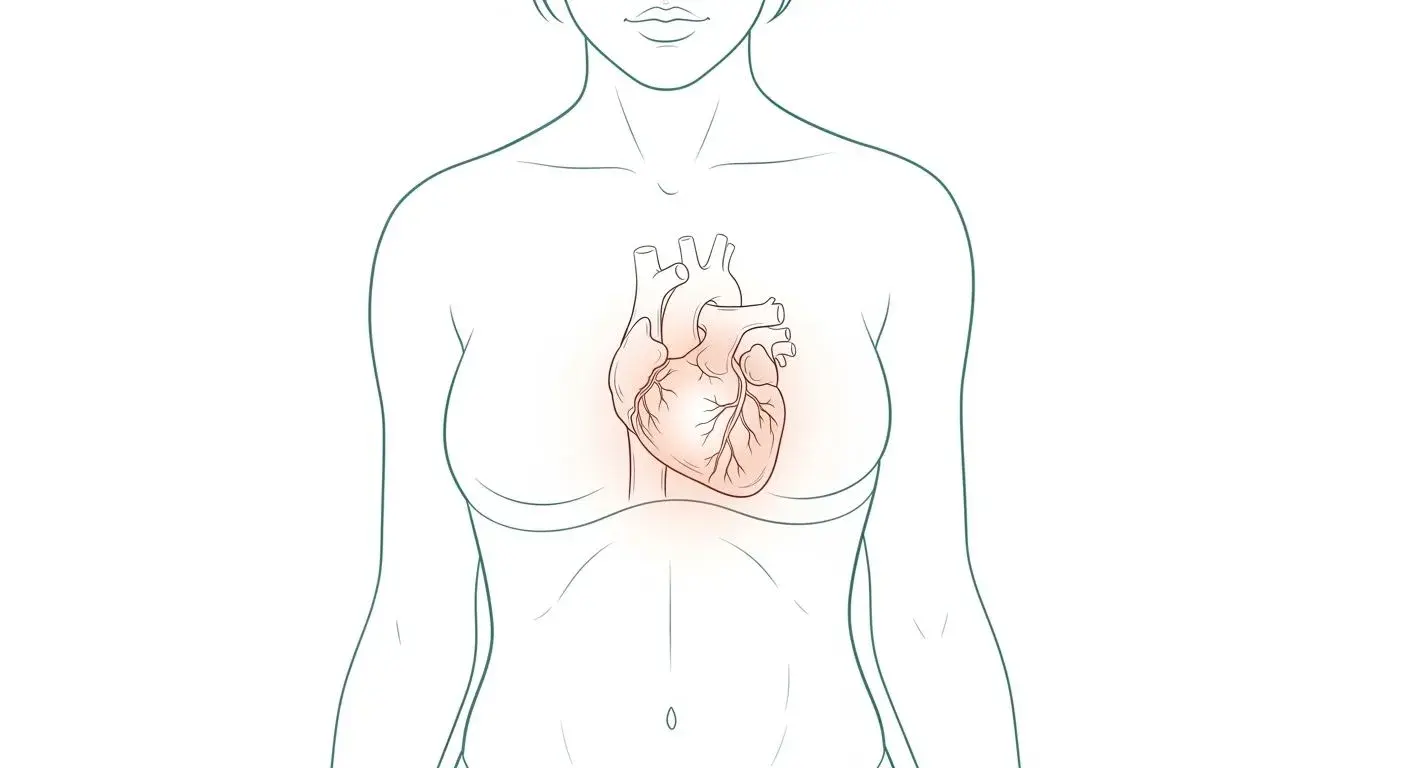
Types of Chest Symptoms in Perimenopause — and Their Causes
Not all chest symptoms in perimenopause have the same origin, and the mechanism matters for treatment:
- Palpitations and racing heart: Most commonly driven by autonomic instability from estrogen decline. Often triggered by hot flashes, caffeine, alcohol, or stress. Typically benign but should be assessed by ECG at least once to rule out arrhythmia.
- Chest tightness and pressure: Can be musculoskeletal (costochondritis is more common in midlife women), anxiety-driven, or vasospastic. Vasospasm — a brief arterial constriction — is more common in estrogen-deficient women and can produce genuine chest tightness without any arterial blockage.
- Anxiety-driven chest symptoms: Perimenopause anxiety is a direct hormonal symptom, not simply a psychological response to life stress. The physical component — tight chest, shallow breathing, sense of dread — is real and can be indistinguishable from cardiac symptoms at the time of the episode. Our guide to perimenopause anxiety stories and experiences shows how commonly this presents as physical chest symptoms.
A critical misconception is that if tests come back normal, the symptoms are not real or are 'just anxiety.' Vasospasm and autonomic dysfunction do not always show on standard ECGs or stress tests. Women in this age group are also historically under-investigated for cardiac symptoms, meaning genuine pathology can be missed in the other direction. Any new chest symptoms in a woman over 40 warrant proper cardiac evaluation — hormonal cause should be considered alongside, not instead of, investigation.
What Helps — and When to Seek Urgent Care
Seek emergency care immediately for chest pain accompanied by pain radiating to the jaw, arm, or back; sudden shortness of breath; sweating; or a sense of impending doom. These are cardiac red flags regardless of menopausal status. Women in their late 40s and 50s are in a transitional period of cardiovascular risk elevation — estrogen's protective effect is reducing — and heart attack in this group is frequently misdiagnosed or delayed.
For hormonally-driven chest symptoms without a cardiac cause, HRT is often the most effective intervention. Estrogen stabilises the autonomic nervous system, reduces palpitation frequency, and can resolve vasospastic chest tightness. Many women report significant improvement in palpitations within weeks of starting HRT. The relationship between HRT and cardiovascular health is nuanced — for most women under 60 and within 10 years of menopause onset, HRT has a neutral or beneficial cardiovascular effect, but this should be discussed with a prescribing clinician.
Lifestyle factors that aggravate autonomic instability — caffeine, alcohol, disrupted sleep, and unmanaged stress — are worth addressing regardless of HRT status. Stress is a particularly powerful trigger for both palpitations and chest tightness in perimenopause; our article on stress and menopause covers the cortisol-estrogen interaction that makes this relationship so direct.