
At What Age Does Perimenopause Actually Begin?
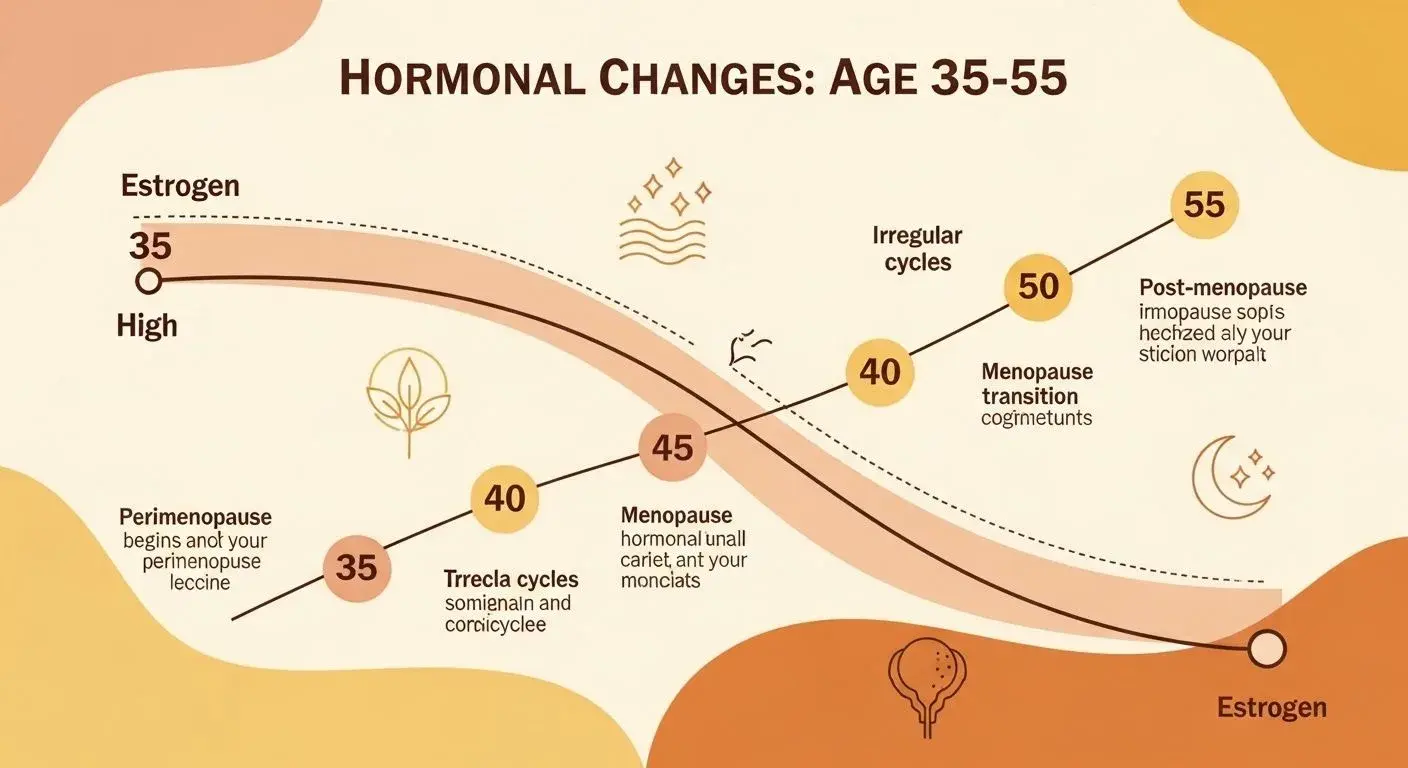
The textbook answer is that perimenopause begins in the mid-to-late 40s, but this significantly underestimates how many women begin the transition earlier. Research suggests that ovarian function starts its gradual decline from the mid-30s, with meaningful hormonal fluctuations — and associated symptoms — beginning for some women as early as 35.
Perimenopause at 38 or even 35 is not as rare as commonly believed. Early perimenopause (before 45) is estimated to affect up to 12% of women and is clinically distinct from premature ovarian insufficiency (POI), which occurs before 40 and requires separate management. The distinction matters because standard GP reassurance — 'you are too young for menopause' — is statistically incorrect for a meaningful proportion of women presenting in their late 30s.
Risk factors for earlier perimenopause include: family history (the strongest predictor), smoking, surgical removal of one ovary, chemotherapy or pelvic radiation, autoimmune conditions, and chronic high stress. Importantly, stress and menopause share a bidirectional relationship — chronic stress elevates cortisol, which suppresses ovarian function and can accelerate the hormonal decline.
Can You Test for Perimenopause? What Blood Tests Reveal and Miss
The perimenopause blood test most GPs use measures FSH (follicle-stimulating hormone). A raised FSH indicates the pituitary gland is working harder to stimulate the ovaries — a sign of declining ovarian reserve. However, in early perimenopause, FSH fluctuates enormously: it can appear normal one month and elevated the next. A single normal FSH reading does not rule out perimenopause.
Common misconception: Many women are told a blood test will confirm whether they are perimenopausal. In women under 45, NICE guidelines (UK) do not actually recommend blood tests as a primary diagnostic tool — the diagnosis should be made clinically, based on symptoms, cycle changes, and age. Over-reliance on single blood tests leads to significant underdiagnosis and unnecessary delays in treatment.
Oestradiol levels are similarly unreliable in isolation during perimenopause. Because oestrogen surges chaotically before declining overall, a mid-cycle test may show high-normal oestradiol in a woman with clear perimenopausal symptoms. AMH (anti-Mullerian hormone), which reflects ovarian reserve, provides a more stable picture and can be requested privately if NHS testing is inconclusive. For emotional symptoms that often accompany this period, perimenopause anxiety stories illustrates how hormonal change manifests psychologically before periods even become irregular.
What Actually Happens to Hormones During Perimenopause
Perimenopause is not a smooth oestrogen decline — it is a chaotic oscillation. In early perimenopause, oestrogen levels can actually spike higher than premenopausal norms before crashing, which is why some women in their early 40s experience symptoms that feel more like oestrogen excess (breast tenderness, heavy periods, fluid retention) rather than deficiency. This phase is the most unpredictable and the most poorly described to patients.
Progesterone typically declines first, before oestrogen becomes erratic. This relative progesterone insufficiency — not yet low oestrogen — drives many early perimenopausal symptoms: worsened PMS, heavier periods, anxiety, poor sleep, and mood volatility. Many women treated for these symptoms in their late 30s are actually in early perimenopause, not 'stress' or 'anxiety disorder'.
Edge case: Ovulation does not stop in perimenopause — it becomes irregular and unpredictable. Symptoms of ovulation (mid-cycle pain, cervical mucus changes, mood shifts) can become more pronounced and longer-lasting in perimenopause as the cycle lengthens. Women experiencing symptoms of ovulation during perimenopause are not imagining it; the periovulatory hormone surge simply becomes less predictable and more intense as ovarian reserve declines.