
Why There Is No Single Official Number — and What That Means for You
You may have seen references to '34 symptoms of menopause' — a figure popularised by advocacy groups and widely shared online. The number itself is not a clinical consensus; different medical bodies list different symptoms depending on how broadly they define menopause-related change. What matters is not the count, but understanding that menopause is a whole-body hormonal transition that affects the brain, skin, bones, cardiovascular system, digestive tract, and nervous system — not just the reproductive organs.
The symptoms that receive the least clinical attention are often the most distressing in daily life: brain fog, sudden tinnitus, body odour changes, formication (crawling skin sensations), and electric shock feelings. Many women experiencing these are reassured there is 'nothing wrong' because standard blood tests return normal ranges — which, as discussed in our guide to menopause itchy ears, reflect the limitations of snapshot hormone testing rather than the absence of hormonal disruption.
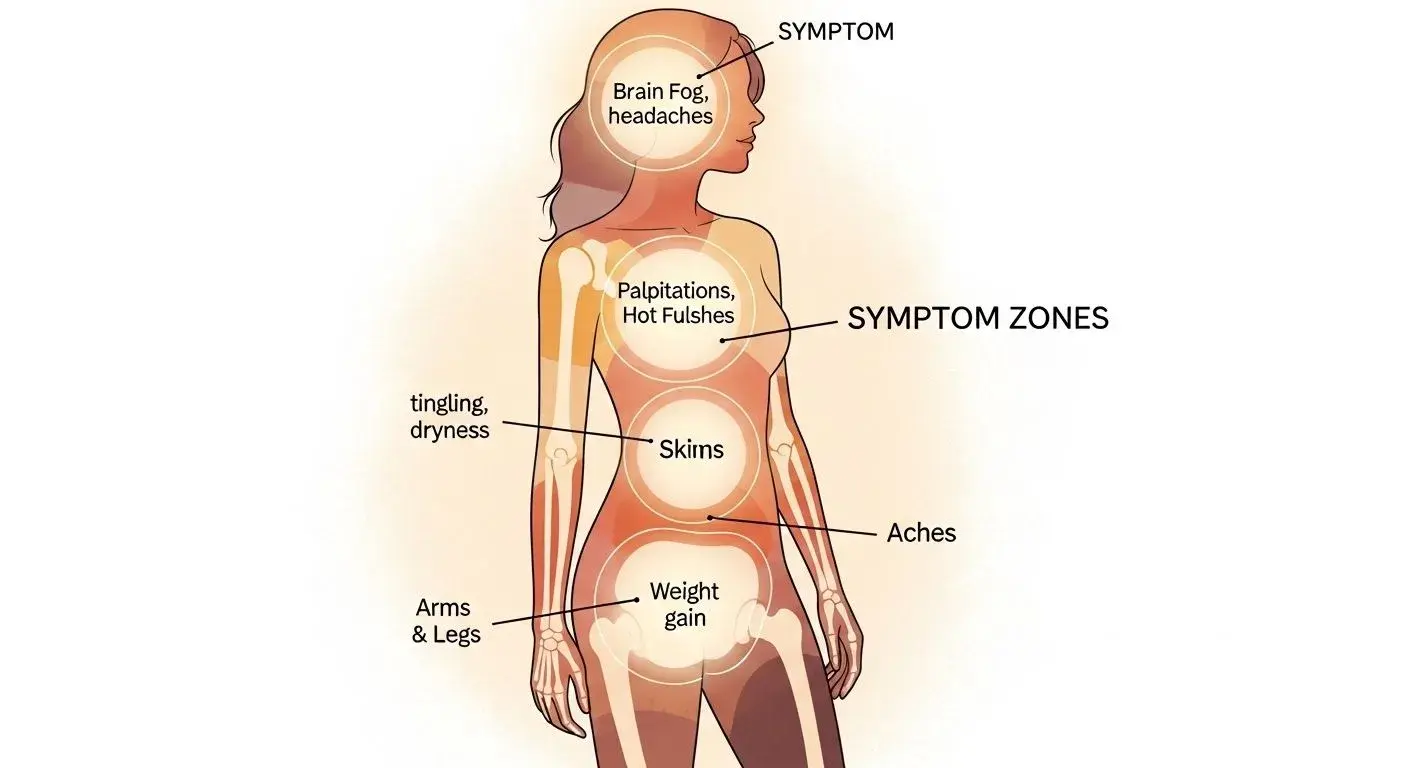
The 30 Symptoms of Menopause: Physical, Neurological, and Emotional
The following covers the most consistently reported symptoms across perimenopause, menopause, and the postmenopausal years:
- Hot flushes — Sudden heat waves, often with sweating and reddening, driven by hypothalamic thermoregulation disruption.
- Night sweats — Nocturnal hot flushes that fragment sleep architecture.
- Irregular periods — Cycles becoming shorter, longer, heavier, or skipping entirely during perimenopause.
- Fatigue and unrefreshing sleep — A hallmark of oestrogen's impact on sleep quality and mitochondrial function.
- Brain fog — Difficulty with word retrieval, short-term memory, and concentration.
- Mood changes and irritability — Driven by oestrogen's role in serotonin and dopamine regulation.
- Anxiety — New or worsened anxiety, including panic attacks, often emerging in perimenopause before other symptoms.
- Low libido — Reduced sexual desire linked to falling testosterone and oestrogen.
- Vaginal dryness — Loss of vaginal lubrication and elasticity from oestrogen withdrawal.
- Painful sex — Related to vaginal atrophy; often undertreated because women do not raise it with their GP.
- Urinary urgency and frequency — The bladder and urethra have oestrogen receptors; their loss causes overactivity.
- Recurrent UTIs — Vaginal and urethral tissue changes increase infection susceptibility.
- Joint pain and stiffness — Oestrogen has anti-inflammatory properties; its loss increases joint inflammation.
- Muscle loss — Sarcopenia accelerates without oestrogen's anabolic support.
- Weight gain (particularly abdominal) — Visceral fat deposition driven by insulin resistance and oestrogen decline.
- Skin dryness and thinning — Collagen loss of up to 30% in the first 5 years post-menopause.
- Acne or oily skin — Androgen dominance relative to oestrogen drives sebum changes.
- Hair thinning — Telogen effluvium triggered by hormonal shift, often worsened by nutritional deficiency.
- Facial hair growth — Relative androgen excess drives coarser chin and upper lip hair.
- Palpitations — Increased awareness of heartbeat; oestrogen modulates cardiac electrical activity.
- Headaches and migraines — Fluctuating oestrogen is a potent migraine trigger, particularly in perimenopause.
- Tingling and pins and needles — Peripheral nerve hypersensitivity caused by oestrogen withdrawal.
- Electric shock sensations — Reported at sleep onset; related to CNS oestrogen effects on neurotransmission.
- Itchy skin (including scalp and ears) — Reduced skin barrier function and histamine sensitivity. See our guide to menopause itchy scalp for detailed causes.
- Burning skin sensations — Prickling or heat sensations on the skin surface without external cause.
- Tinnitus — Ringing or buzzing in the ears linked to inner-ear oestrogen receptor changes.
- Changes in body odour — Hormonal shifts alter sweat gland composition and skin microbiome.
- Digestive changes — Bloating, changes in bowel frequency, and increased gut sensitivity are common but poorly publicised.
- Dry eyes and mouth — Oestrogen supports mucosal membrane hydration throughout the body.
- Bone density loss (osteoporosis risk) — Oestrogen inhibits osteoclast (bone breakdown) activity; its loss accelerates bone resorption.
What the Full Symptom List Reveals — and When to Take Action
The important pattern in this list is that almost every symptom traces back to a few shared mechanisms: oestrogen's role in the nervous system, skin barrier, immune regulation, and metabolic function. This is why a single intervention like HRT can improve dozens of symptoms simultaneously — and why fragmented, symptom-by-symptom treatment often leaves women frustrated.
Common misconception: Many women wait until periods have stopped for 12 months (the clinical definition of menopause) before seeking hormonal support. But the most disruptive phase for most women is perimenopause — when hormones are most erratic — which can last 4-10 years. Waiting until 'official' menopause means enduring the most turbulent phase without support.
If you are experiencing five or more of the symptoms listed above and are in your 40s, a conversation with a menopause-informed GP or specialist is warranted regardless of what your blood tests show. Symptom burden — not test results alone — is the appropriate guide to treatment.