
How Many Stages of Menopause Are There — and Where Does the Number Come From?
The concept of '7 stages of menopause' draws from the STRAW+10 staging system (Stages of Reproductive Aging Workshop), the most widely used clinical framework for describing the female reproductive lifespan. While STRAW+10 technically defines 10 stages, the commonly cited '7 stages' framework simplifies this into a more accessible sequence that captures the key transitions most women will recognise from their own experience.
The 7-stage model covers the full arc from reproductive health through the perimenopausal transition to post-menopause. Understanding where you are in this arc is clinically useful because different stages have different dominant symptoms, different treatment priorities, and different long-term health considerations. A woman in early perimenopause and a woman two years post-menopause are experiencing fundamentally different hormonal environments, even though both might describe 'menopause symptoms.'
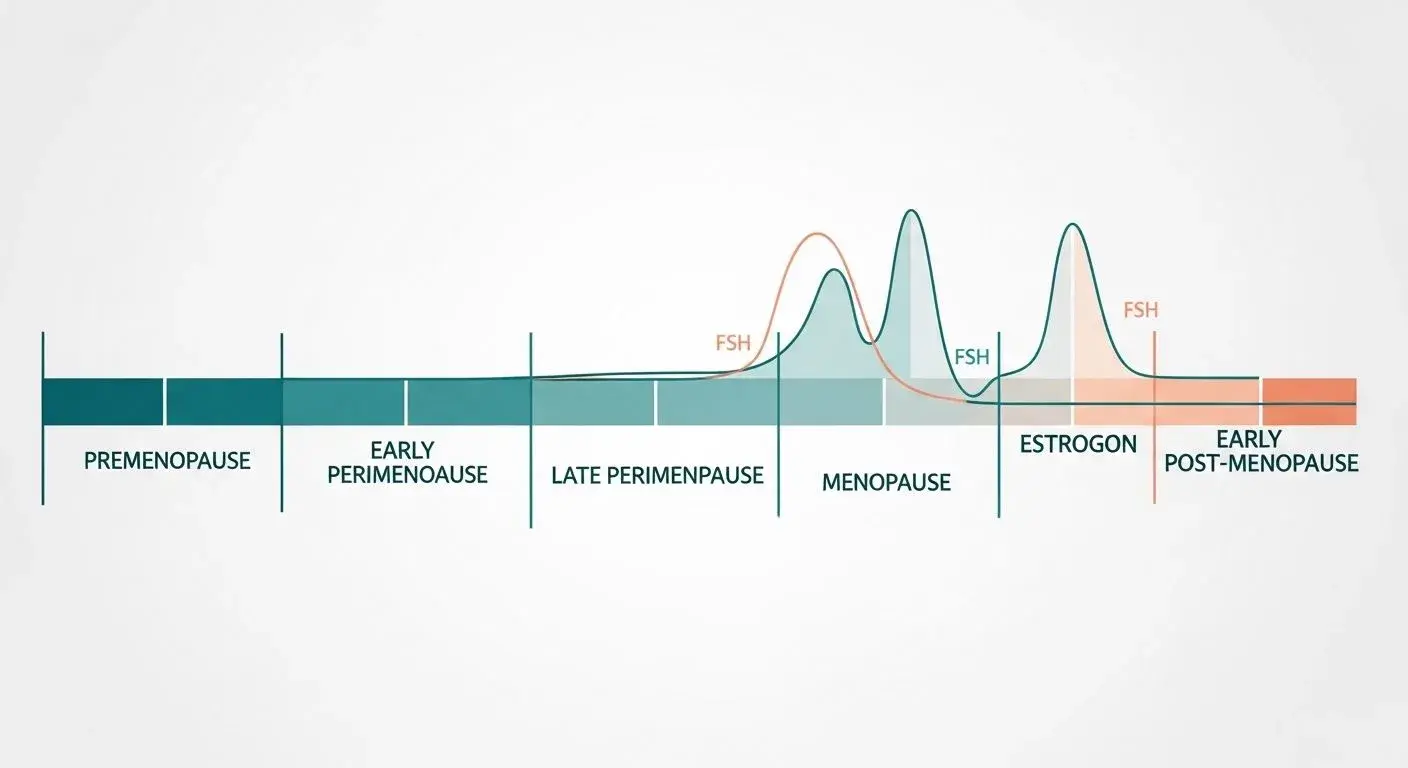
The 7 Stages of Menopause: What Happens at Each Phase
- Premenopause: Reproductive years with regular cycles. Ovarian function is intact. No perimenopausal symptoms. Hormones (FSH, estrogen, progesterone) follow a predictable monthly pattern.
- Early perimenopause: Cycles remain regular but FSH begins to rise. Estrogen fluctuates erratically. First symptoms appear — often mood changes, sleep disruption, PMS intensification, or subtle cognitive changes. Many women do not recognise this as perimenopause.
- Late perimenopause: Cycles become irregular — skipped periods, shorter or longer intervals. Hot flashes, night sweats, and vaginal changes become more prominent. This is typically the most symptomatic phase.
- Menopause: Defined retrospectively as 12 consecutive months without a menstrual period. A single point in time rather than a phase. Average age in the UK is 51.
- Early post-menopause (years 1 to 6): Vasomotor symptoms (hot flashes, night sweats) often continue or even peak. The most rapid phase of bone density loss. Cardiovascular risk begins to rise. Vaginal atrophy symptoms are common.
- Late post-menopause (years 6 to 10): Vasomotor symptoms typically reduce. Urogenital symptoms (dryness, recurrent UTIs) often become more prominent. Long-term cardiovascular and bone health become primary concerns.
- Advanced post-menopause (beyond 10 years): Estrogen has been consistently low for a decade or more. The health focus shifts to managing the cumulative effects of long-term estrogen deficiency — cardiovascular health, cognitive function, and bone density.
A common misconception is that menopause is a destination — something that happens and is then over. In reality, the effects of estrogen decline continue and evolve for decades. Skin changes are a visible example: collagen loss begins in perimenopause and continues post-menopause, which is why menopausal skincare remains relevant long after the final period. Ear symptoms such as tinnitus and itching can also emerge or worsen at different stages; our guide to menopause itchy ears treatment explains how hormonal ear changes develop across the stages.
How to Know Which Stage You Are In — and Why It Matters for Treatment
Stage identification matters clinically because treatment priorities differ. In early perimenopause, the focus is often on managing erratic symptoms and supporting mental health — progesterone sensitivity and mood dysregulation are prominent. In late post-menopause, the priority shifts toward preventing the downstream consequences of long-term estrogen deficiency: bone protection, cardiovascular support, and urogenital health.
Blood tests (FSH, estradiol, LH) provide limited staging information in perimenopause because hormones fluctuate so much that a single test can be misleading. Cycle pattern and symptom history are more reliable staging tools in practice. Post-menopause staging is straightforwardly date-based from the final menstrual period.
Skincare is one area where stage awareness has practical implications — the skin in early perimenopause behaves differently from post-menopausal skin, and the products that work best reflect that difference. Our article on using vitamin C serum before or after moisturiser covers how to sequence actives that are particularly beneficial in the post-menopausal skin stages.