
Why Anti Hair Fall Products Often Disappoint — and What Changes That
Most anti hair fall shampoos are formulated to address fragile, breakage-prone hair — thickening the shaft, strengthening the cuticle, reducing mechanical damage. This is genuinely useful for breakage. But during perimenopause and menopause, the dominant problem is shedding driven by follicle-level hormonal disruption: follicles cycling out of the growth phase faster than normal due to declining oestrogen and rising androgen sensitivity. No strengthening shampoo addresses that biology.
The distinction matters practically. If your hair is snapping mid-length and leaving short broken pieces, the problem is structural and responds to protein treatments, gentler styling, and moisture-barrier repair. If hairs are coming out with the white bulb intact at the root, the problem is follicular cycling, and the treatment needs to work at scalp level — not hair shaft level. Many women spend months on the wrong category of product because this distinction is never explained on packaging.
Stress is a significant amplifier of hormonal shedding that is frequently underestimated. Cortisol disrupts the hair growth cycle independently of oestrogen, and the two effects compound each other. For women navigating both menopause and elevated stress, the relationship between the two is explored in stress and menopause — managing cortisol is not a soft add-on to a hair fall plan; it is a core component.
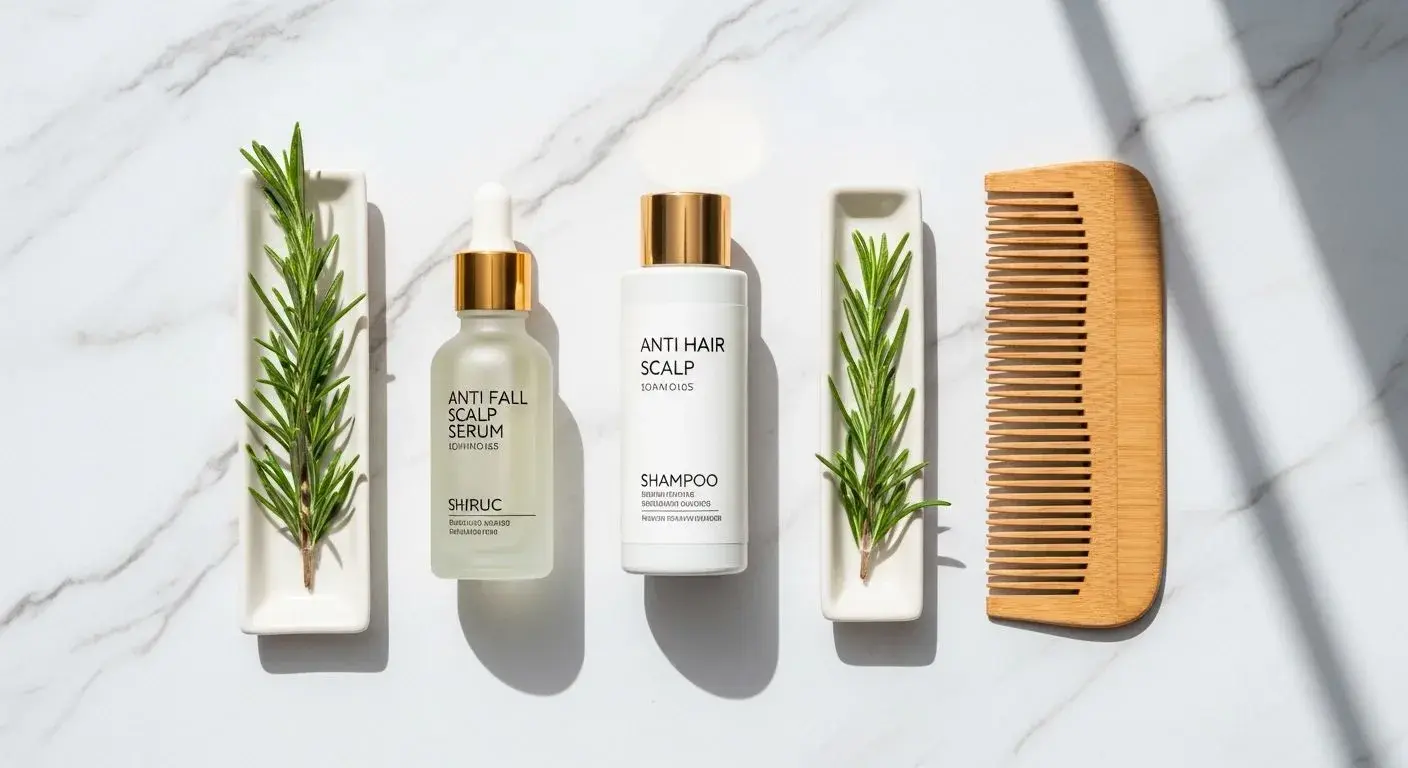
Ingredients and Products That Reduce Shedding — and What to Look For
For hormonal shedding specifically, the ingredients with the most consistent evidence are:
- Minoxidil (2% or 5%): The only topical treatment with robust clinical evidence for androgenic hair loss in women. Extends the anagen growth phase. Requires consistent daily use for a minimum of 16 weeks before evaluating results — the initial shedding surge at weeks 4 to 8 is normal and not a failure signal.
- Rosemary oil: Shown in a controlled trial to match 2% minoxidil in reducing hair count loss over 6 months, with better tolerability on sensitive scalps. Look for leave-on serums containing 1 to 2% rosemary extract rather than diluted rinse-off formulas.
- Caffeine scalp serums: Caffeine applied topically counteracts the follicle-suppressing effects of DHT in lab studies and is well tolerated. Most effective in leave-on formulations applied directly to a dry or slightly damp scalp, not in rinse-off shampoos where contact time is too short.
- Niacinamide: Reduces scalp inflammation that impairs follicle cycling, improves microcirculation, and helps repair the barrier disruption that makes the scalp hypersensitive during hormonal transition.
For women whose shedding coincides with scalp itch and sensitivity, the two conditions share the same hormonal root and should be treated together — see menopause itchy scalp: causes and relief for a combined scalp care approach.
Habits That Quietly Make Shedding Worse
Several common hair care habits accelerate shedding without most women realising. Washing hair too infrequently allows sebum and product buildup to block follicle openings and create a low-grade inflammatory environment — a scalp that itches and sheds more. The idea that washing strips hair and worsens loss is a myth when a gentle, sulphate-free formula is used. Washing 2 to 3 times per week is generally optimal for hormonal scalp health.
Tight hairstyles — ponytails, buns, and braids worn daily — cause traction alopecia along the hairline and temples, a separate condition that compounds hormonal thinning in exactly the areas most vulnerable to perimenopause-related loss. This damage is cumulative and, at the hairline, can eventually become permanent if the mechanical tension continues long enough.
Finally, the trade-off with high-protein diets deserves mention: very low carbohydrate or severely calorie-restricted diets frequently trigger telogen effluvium — sudden diffuse shedding — within 2 to 3 months of starting. Women adopting these diets during perimenopause may attribute the resulting hair loss to hormones rather than nutrition, delaying the correct response. Gradual, moderate dietary changes are significantly less likely to provoke shedding than rapid or extreme ones.