
Why Your Concealer Emphasizes Lines Instead of Hiding Them
The best concealer for mature skin faces an impossible engineering challenge that most formulas fail to solve: it must be pigmented enough to cover dark circles and discoloration while remaining thin and flexible enough not to settle into the fine lines that develop on aging under-eye skin. Traditional concealers achieve coverage through high concentrations of titanium dioxide and iron oxides suspended in waxy bases that provide staying power—exactly what creates the creasing, caking, and emphasized texture that plagues mature skin within hours. The under-eye area loses approximately 40% of its collagen between ages 40 and 60, creating a network of microscopic valleys where conventional concealer pools and oxidizes, making you look more tired at noon than you did before applying any makeup.
Here's what professional makeup artists understand about best under eye concealer for mature skin that beauty counters rarely explain: the darkness you're trying to conceal after 50 comes from three different sources requiring completely different correction approaches. Surface-level hyperpigmentation responds to opaque, full-coverage concealer. Blue or purple undertones from visible veins beneath thinning skin require color-correcting first with peach or salmon tones. Actual shadows from hollowing and volume loss cannot be concealed at all—they need strategic highlighting in specific curves rather than blanket concealer coverage. Using one concealer product to address all three issues simultaneously is why your concealer looks obvious, settles badly, and somehow makes you look more tired despite providing technical coverage.
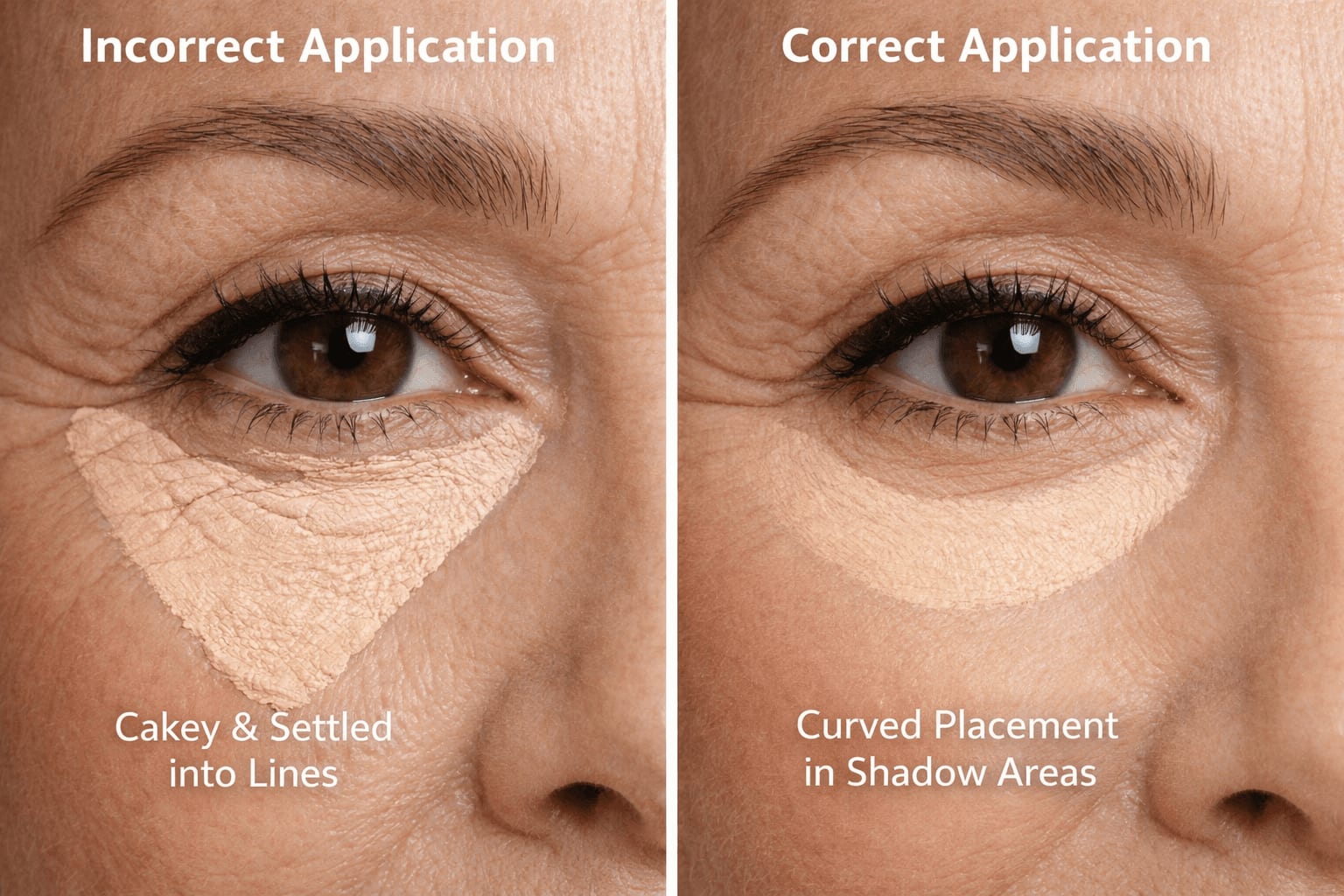
The critical factor most advice misses: best concealer for wrinkles isn't actually about finding wrinkle-proof formulas but about understanding that concealer placement on mature skin requires complete reimagining. The inverted triangle technique popularized on Instagram—where you draw huge triangles of concealer under your eyes—is designed for smooth, firm young skin without genuine hollowing. On mature skin with actual volume loss, this technique deposits heavy product exactly where the deepest creases form, guaranteeing creasing and caking. Instead, concealer on aging skin goes only in the darkest parts of actual shadows and discoloration, applied in thin curved lines that follow the natural contours of your under-eye area rather than geometric shapes that ignore your facial anatomy.
The Color Correction Step Everyone Skips
The best under eye corrector for mature skin is the step that transforms results but gets skipped because it seems complicated or unnecessary. As skin thins with age, the vascular network beneath becomes visible, creating blue, purple, or even greenish undertones that no amount of regular concealer can adequately cover. Attempting to conceal these undertones with standard concealer requires layering so much product that creasing becomes inevitable. Instead, apply a thin layer of peach or salmon color corrector only on areas with visible undertones before any concealer. The corrector neutralizes the color, allowing your concealer to work as a true coverage product rather than having to fight underlying color problems.
What dermatologists observe about best concealer for dark circles mature skin that cosmetic companies rarely emphasize: true dark circles from hyperpigmentation worsen with hormonal changes during menopause, requiring genuine corrective ingredients rather than just coverage. Look for concealers containing niacinamide, vitamin C derivatives, or caffeine that actively treat pigmentation and puffiness while providing coverage. These treatment concealers cost more but deliver dual benefits—immediate cosmetic improvement plus gradual reduction of the underlying issue. Over weeks of consistent use, you'll need less product as the concealer's active ingredients diminish the darkness you're covering.
Which Concealer Formulas Actually Work on Aging Skin
The best hydrating concealer for mature skin category represents recent formulation breakthroughs that finally address the hydration-coverage paradox. Traditional concealers use mattifying ingredients to increase longevity, but these actively dehydrate already-moisture-depleted mature skin, creating the crepey, emphasized-texture appearance within hours. Modern serum concealers contain encapsulated hyaluronic acid or glycerin microspheres suspended in lightweight pigment bases—they provide genuine coverage while delivering continuous hydration throughout wear. These formulas feel almost too thin when you first apply them, but they build to adequate coverage through layering while maintaining the flexibility that prevents creasing on moving, expressive under-eye skin.
For best concealer for mature skin over 60 specifically, coverage needs shift toward correction rather than opacity. At this stage, you're dealing with significant volume loss creating deep hollows, severe thinning revealing extensive vascular networks, and pronounced texture from decades of collagen decline. Heavy, opaque concealer looks masklike and artificial on these dramatic structural changes. Instead, you need illuminating concealers with light-reflecting particles that work optically to minimize shadows rather than attempting to cover them with pigment. These formulas contain pearl or mica that scatter light across irregular surfaces, making hollows less apparent without the heavy coverage that emphasizes every line and wrinkle.
- Serum concealers with hyaluronic acid: Best for dry mature skin with fine lines; hydrates while covering without creasing or settling
- Illuminating concealers with light-reflectors: Ideal for deep hollowing over 60; optically minimizes shadows without heavy coverage
- Cream concealers with oils: Excellent for very dry, crepey under-eyes; provides moisture and coverage but needs setting
- Color correctors in peach or salmon: Essential first step for blue or purple undertones showing through thinning skin
- Avoid: Full-coverage matte concealers: Settle into every line within hours and emphasize texture on moisture-depleted mature skin
The best drugstore concealer for mature skin category has improved dramatically as mass-market brands recognize the aging demographic. Look for formulas explicitly mentioning hydrating ingredients like glycerin, squalane, or sodium hyaluronate in the first five ingredients rather than focusing on coverage claims. Drugstore concealers lag behind prestige brands primarily in shade range subtlety—they offer fewer nuanced undertone options that perfectly match aging skin's complex coloring shifts. However, the actual concealing and wear technology can be identical if you read ingredient lists carefully. The wand applicator also matters more at drugstore price points; choose doe-foot applicators that allow precise placement rather than sponge tips that deposit excessive product.
Application technique transforms how any concealer performs on best concealer for lines under eyes concerns. Use your ring finger—the weakest finger with the lightest touch—to press concealer into skin using gentle patting motions, never rubbing or dragging which stretches delicate tissue. Apply concealer in thin curved lines following the actual shape of your under-eye darkness rather than geometric triangles. Start with minimal product and build coverage gradually through multiple thin layers rather than attempting adequate coverage with one thick application. Allow thirty seconds between layers for the previous layer to set, which prevents the product overload that causes creasing. This patient, layered approach takes an extra minute but prevents the settling that ruins your makeup by afternoon.
For understanding how concealer selection coordinates with foundation formulas to create cohesive, non-cakey mature makeup, explore our guide to foundation for mature skin over 50 that addresses base product pairing and application order for flawless results.
When Standard Concealer Advice for Mature Skin Completely Fails
The universal recommendation to choose concealer two shades lighter than your foundation fails dramatically for best under eye concealer for over 60 because it ignores how volume loss creates actual shadows that lightening cannot fix. When you have genuine hollowing from fat pad descent, applying concealer significantly lighter than your skin tone creates a reverse raccoon effect—pale concealer sits in the hollow while the surrounding areas remain darker, making the depression more visually apparent rather than less. For severe hollowing, match your concealer to your exact skin tone or even go slightly deeper, using the concealer to even texture rather than brighten. Reserve brightening concealers only for the highest point of your under-eye area where you want to attract light, not for the entire hollow.
Another scenario where conventional wisdom backfires: the advice to set concealer with powder to increase longevity. While this works on young, smooth skin, powder on mature under-eyes creates the exact creasing and emphasized texture you're trying to avoid. The best concealer for dry mature skin needs zero powder or, at most, the tiniest amount of finely-milled translucent powder pressed—not dusted—only into the inner corner where tear duct moisture might cause migration. Leave the rest of your under-eye area powder-free, allowing the concealer to maintain its flexible, hydrated finish that moves with your skin rather than cracking across it.
The critical contradiction between Instagram tutorials and real mature skin: those dramatic under-eye brightening techniques using multiple shades of concealer and extensive baking work on twenty-something influencers with minimal texture and no genuine volume loss. Attempting these techniques after 60 creates a strange, artificial appearance where your under-eye area looks completely disconnected from the rest of your face—too bright, too flat, too obviously covered. Professional makeup artists working on mature clients use concealer sparingly and strategically, prioritizing natural-looking correction over dramatic transformation. The goal is to look like yourself on a well-rested day, not like you're wearing stage makeup.
What actually fails that nobody discusses: assuming the best under eye brightener for mature skin works the same way throughout your entire under-eye region. The inner corner near your tear duct, the central under-eye area, and the outer corner near crow's feet all have different skin characteristics and coverage needs. The inner corner tends to be darker and can handle more coverage. The central area has the most movement and requires the most flexible, crease-resistant formula. The outer area has pronounced texture from repeated squinting and needs minimal product with light-reflecting properties rather than opacity. Using one concealer shade and formula everywhere ignores these distinct requirements and creates the patchy, settled appearance that plagues mature makeup.
The hidden challenge with best dark spot concealer for mature skin involves the temptation to use heavy coverage on age spots and hyperpigmentation. Full-coverage concealer on textured mature skin looks obvious and emphasizes the very spots you're trying to hide by creating a flat, opaque patch that doesn't match the natural variation and dimension of your skin. Instead of concealing dark spots completely, use a thin layer of corrector in a complementary tone—peach for brown spots, lavender for yellow undertones—then blend your regular foundation over it. This color-correction approach minimizes the appearance of discoloration without the obvious patch of concealer that draws more attention than the original spot.
For comprehensive strategies on managing all aspects of makeup application during hormonal transitions, including how concealer fits into your complete routine from skincare through setting, see our complete makeup guide for menopausal skin changes that addresses every product category and how declining estrogen affects your entire approach to cosmetics.