
Why Menopause Causes Cold Flashes and Chills — Not Just Hot Flashes
When most people think of menopause temperature symptoms, hot flashes come to mind. But cold flashes — sudden waves of chill, shivering, or a persistent sensation of being cold that does not match the ambient temperature — are a real and common perimenopause symptom that receives far less attention. For some women, cold flashes are their primary temperature complaint; others experience alternating hot and cold flashes in rapid succession.
The mechanism links back to estrogen's role in the hypothalamus — the brain region that acts as the body's thermostat. Estrogen helps maintain a stable thermoneutral zone: the range of body temperatures the hypothalamus tolerates before triggering a cooling or warming response. When estrogen declines and fluctuates, this zone narrows dramatically. Small variations in core body temperature — the kind the body would normally ignore — trigger either a hot flash (blood vessels dilate, sweating begins) or a cold flash (blood vessels constrict, shivering begins). Both are the same dysregulated system responding to the same trigger.
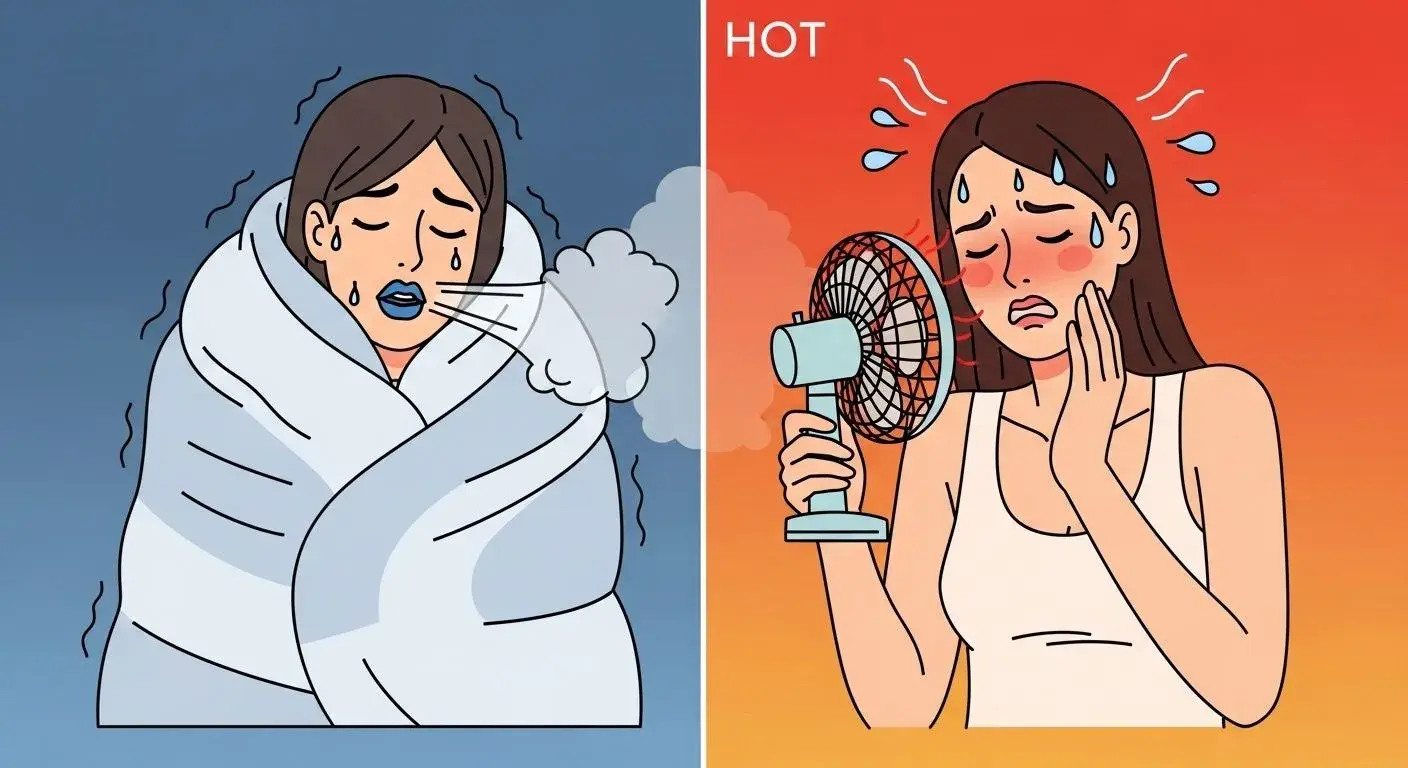
Cold flashes in perimenopause often follow a hot flash. The body's rapid heat-dissipation response — sweating, vasodilation — can overcorrect, leaving skin damp and blood vessels contracted, producing an intense chill seconds or minutes after intense heat. Women who describe feeling 'boiling then freezing' are experiencing exactly this thermoregulatory overcorrection.
Feeling Cold All the Time vs Cold Flashes — and Other Causes to Rule Out
There is an important distinction between episodic cold flashes and a persistent sense of feeling cold all the time in perimenopause. Episodic cold flashes are thermoregulatory events — sudden, brief, and often associated with a preceding hot flash or night sweat. A constant, generalised feeling of coldness that does not resolve is a different picture and has a broader differential diagnosis.
Hypothyroidism is the most important condition to rule out. It is significantly more common in midlife women, shares many symptoms with perimenopause (fatigue, cold intolerance, mood changes, brain fog), and is straightforwardly diagnosed with a TSH blood test. Iron deficiency anaemia also produces chronic cold sensitivity and is frequently present in perimenopausal women due to heavier irregular periods. Both should be checked before attributing persistent coldness to hormones alone.
A common misconception is that cold symptoms in menopause are trivial compared to hot flashes. For women experiencing menopause cold shivers at night, the sleep disruption can be just as severe as night sweats — and harder to explain to a partner or clinician who expects heat-based symptoms. If you are also experiencing skin sensations alongside temperature symptoms, our article on burning skin sensation and prickly heat in menopause explains how nerve sensitivity and thermoregulation intersect.
What Helps With Menopause Cold Flashes and Chills
HRT addresses the root cause by restoring estrogen levels and widening the thermoneutral zone. Women who start HRT typically see improvement in both hot and cold flash frequency within 4 to 8 weeks. For cold flashes specifically, the benefit comes from stabilising the hypothalamic thermostat rather than treating heat or cold in isolation.
For women not on HRT, layering strategies are the most practical approach: moisture-wicking base layers that move sweat away from skin (reducing the post-hot-flash chill), keeping a light layer accessible at night, and avoiding rapid temperature changes that can trigger the hypothalamic overcorrection. Avoiding triggers that narrow the thermoneutral zone further — particularly alcohol, spicy food, and large temperature shifts — can meaningfully reduce both hot and cold flash frequency.
Where standard advice fails is in dismissing cold flashes as less clinically significant than hot flashes. Clinicians rarely ask about cold symptoms, and women rarely volunteer them, assuming they are not 'real' menopause symptoms. Ear symptoms — including a sense of fullness or cold sensitivity in the ears — occasionally accompany cold flashes and temperature dysregulation. Our guide on menopause itchy ears treatment explains how hormonal changes affect the ear canal and surrounding tissue.