
Why Menopausal Skin Needs Dewy Setting Spray (But Not All Work)
Dewy face mists solve a critical problem for menopausal skin: they add back the moisture glow that disappears when estrogen drops. As skin produces 40% less natural oil during menopause, the healthy luminosity of well-hydrated skin vanishes, leaving makeup looking flat, dull, and chalky. A properly formulated dewy setting spray creates the optical illusion of hydrated skin while actually delivering moisture that keeps makeup from cracking into fine lines.
However, not all glowy skin mists work on mature skin. Many dewy sprays designed for younger skin contain oils that sit on the surface without absorbing, creating a greasy appearance that looks more sweaty than dewy within an hour. The key difference lies in particle size and humectant concentration—effective menopausal formulas use micro-fine mists with glycerin or hyaluronic acid that actually penetrate rather than coat. Understanding this distinction prevents wasting money on products that promise glow but deliver shine.
The timing of application also matters more during menopause than it did in your 30s. Applying dewy spray over completely dry makeup rehydrates the surface and revives the finish, but applying it over makeup that's still setting causes everything to slide and separate. Most women discover this through trial: the same product that looks terrible applied immediately after foundation looks gorgeous when used 10 minutes later or as a midday refresher. Learn more foundational techniques in our complete makeup guide for menopausal skin.
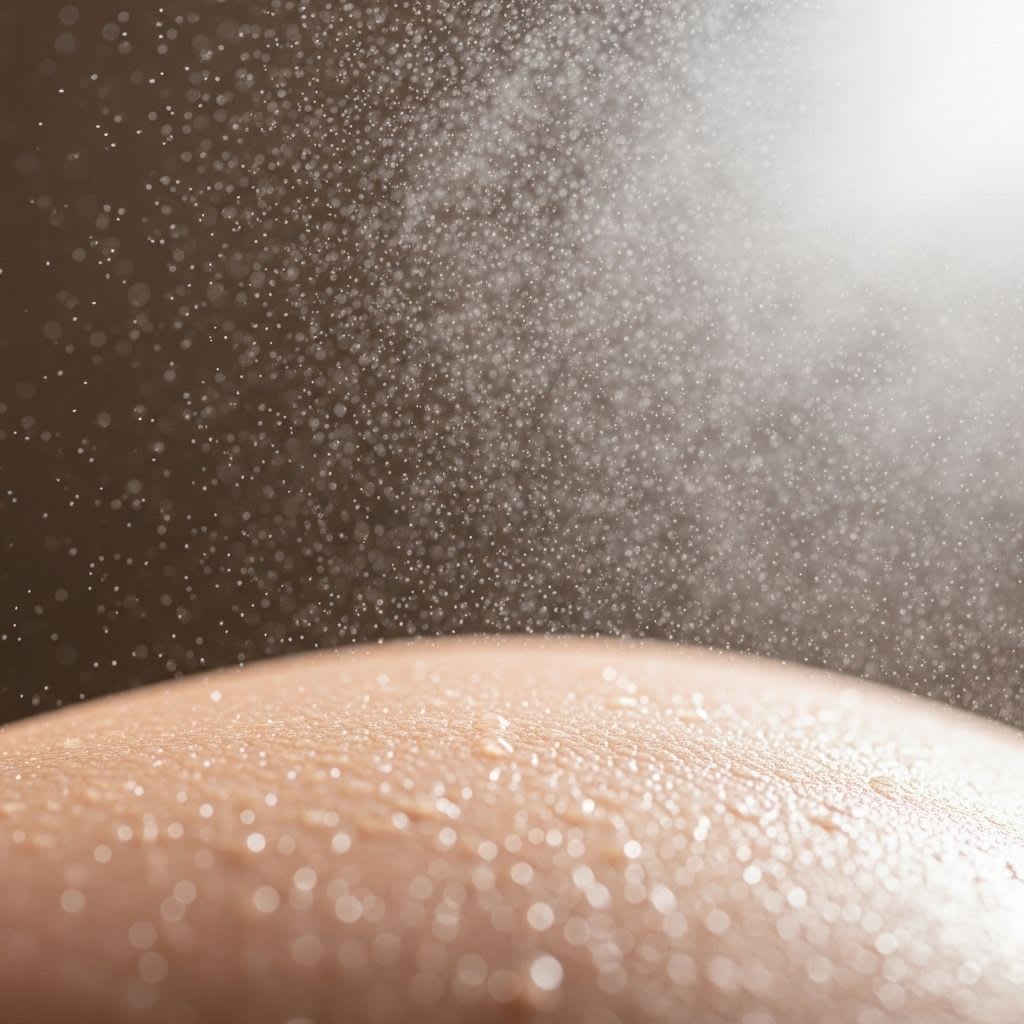
Common Misconceptions About Dewy Finish Setting Sprays
Myth: Dewy Means Oily or Greasy Looking
Many women avoid dewy sprays because they fear looking greasy, but this confuses two completely different finishes. Dewiness is a subtle luminosity that makes skin look healthy and plump, like you just drank three glasses of water and got perfect sleep. Greasiness is an uneven, shiny slick concentrated on the T-zone that screams excess oil. On menopausal skin that produces minimal sebum, achieving actual greasiness requires deliberate over-application of heavy oils.
The distinction becomes clear in photographs: dewy skin has even, soft-focus radiance across the entire face with no sharp shine points, while oily skin shows concentrated bright spots on the forehead and nose with visible pores. Quality dewy face sprays contain light-diffusing particles and humectants that create the first effect without the second. If your spray makes you look greasy, it's poorly formulated for mature skin—not evidence that dewy finishes don't work for you.
Myth: Setting Spray and Finishing Spray Are Identical
The beauty industry uses these terms interchangeably, creating confusion about when to use which product. Setting sprays contain ingredients like alcohol or film-formers that help makeup adhere and resist fading—they're functional tools applied before or after makeup. Finishing sprays focus purely on aesthetic finish, adding dewiness or eliminating powder appearance without necessarily extending wear time.
For menopausal skin, dewy finish sprays that combine both functions work best—they lock makeup in place while adding moisture and glow. Single-purpose finishing mists often lack the staying power needed when skin doesn't produce natural oils to help makeup adhere. The trade-off: combination sprays cost more but eliminate the need for multiple products. Check ingredients for both film-formers like acrylates and humectants like glycerin to identify true dual-purpose formulas. Explore more product selection guidance in our best makeup brands for women over 40.
How to Choose and Use Dewy Sprays on Menopausal Skin
Ingredient Markers That Predict Success
Effective dewy setting sprays for menopausal skin share specific ingredient patterns. Look for glycerin or hyaluronic acid in the first five ingredients—these humectants actually hydrate rather than just creating surface shine. Avoid formulas listing mineral oil or heavy silicones early, as these sit on dehydrated skin without absorbing, creating that greasy appearance. Light-reflecting particles should appear as 'mica' or 'pearl powder' rather than chunky glitter, ensuring subtle radiance instead of obvious sparkle.
Alcohol content presents a paradox: some alcohol helps the spray dry down and set makeup, but too much exacerbates dryness. If alcohol appears first or second in ingredients, skip it—that formula will initially create dewiness that vanishes within 90 minutes as it strips moisture. Mid-list alcohol in combination with strong humectants works better, providing quick-dry convenience without the dehydrating aftermath. Test any new spray on your inner forearm first; if it feels tight or dry after 10 minutes, it will do the same to your face despite promising dewiness.
Application Technique for Maximum Glow Without Disruption
The distance you hold the spray bottle determines whether you achieve dewiness or create droplet disasters. Hold the bottle 8-10 inches from your face and mist in a 'T' or 'X' pattern—one spray across your forehead, one down the center of your face. Closer application creates visible wet spots that disturb makeup, while farther misting produces such fine coverage that it doesn't actually add moisture. The mist should feel like a barely-there fog, not distinct droplets hitting your skin.
Timing matters critically: apply dewy spray as the absolute final step after all makeup has set for at least 5-10 minutes. If you spray over powder before it's settled, you'll create muddy patches. For all-day dewiness, carry a travel-size bottle for midday refresh—one light mist around 2-3 PM revives makeup that's gone flat without requiring full touch-ups. This is something experienced users do instinctively but beginners often miss, assuming one morning application suffices for 12-hour wear.
When Dewy Sprays Make Things Worse
Dewy finish sprays fail during extreme skin dehydration or when used over incompatible products. If your skin is so dry that moisturizer absorbs instantly leaving no trace, dewy spray will evaporate just as quickly, providing zero benefit while potentially reactivating and disrupting your makeup. In these cases, the honest recommendation is to fix the underlying dehydration first through intensive moisturizing routines for 1-2 weeks before expecting any spray to create lasting dewiness.
Similarly, dewy sprays over ultra-matte foundations or heavy powders create an unnatural contrast—dewy skin with completely flat, matte makeup looks disjointed and artificial. The limitation is real: you cannot achieve cohesive dewiness by adding spray to an entirely matte makeup look. Instead, the entire approach must shift toward luminous foundations, minimal powder, and then dewy spray as enhancement rather than transformation. This represents a complete makeup philosophy change that some women resist, preferring the security of matte products they've used for decades.