
Why Menopause Changes Your Hair Texture — Not Just Its Thickness
Most discussions about menopause and hair focus on thinning and shedding — but frizz and texture change are just as common and far less talked about. The mechanism is distinct: oestrogen directly supports sebum production in the scalp and helps maintain the hair shaft's moisture-binding proteins. When oestrogen declines, the hair fibre itself changes. The cuticle — the outermost layer of each strand — lifts more easily, allows moisture to escape, and absorbs atmospheric humidity unevenly. That is what creates the wiry, unpredictable frizz that feels completely different from the frizz you managed in your 30s.
Two common misconceptions worth clearing up immediately. First, many women assume their frizz is a styling or climate problem and buy new humidity-control sprays — only to find them ineffective. Menopausal frizz is a structural issue originating inside the hair shaft, and humidity products that work on the surface provide minimal benefit. Second, there is a widespread belief that hair becomes uniformly coarser after menopause. In reality, many women experience a mix of finer, more fragile strands alongside wiry frizzy ones — making a single product approach unlikely to work for the whole head.
Chronic stress — which often peaks during perimenopause — compounds the problem by elevating cortisol, which further disrupts sebum balance and impairs the scalp microbiome. Understanding the broader hormonal context matters here: as explored in our guide to stress and menopause, cortisol and oestrogen interact closely — and the effects show up in hair texture as much as in mood.
Do Keratin Treatments Work for Menopausal Hair — and What Are the Real Risks?
Keratin treatments smooth and seal the cuticle, temporarily reducing frizz for 3 to 5 months. For menopausal hair, they can be genuinely effective — but the key word is 'temporarily', and not all treatments are equal or safe for this hair type.
Here is the trade-off that rarely gets stated: traditional keratin treatments use formaldehyde or formaldehyde-releasing chemicals to bond the protein to the cuticle. For hair that is already thinner and more porous due to oestrogen loss, repeated formaldehyde-based treatments can cause cumulative fibre damage over time, leading to increased breakage despite smoother initial appearance. This is the case where standard advice — 'get a salon keratin treatment' — requires modification for menopausal hair.
What to look for instead:
- Formaldehyde-free keratin treatments: Brands using glyoxylic acid or amino acids as the active bonding agent. Results last slightly shorter (2-3 months) but are safer for compromised hair structure.
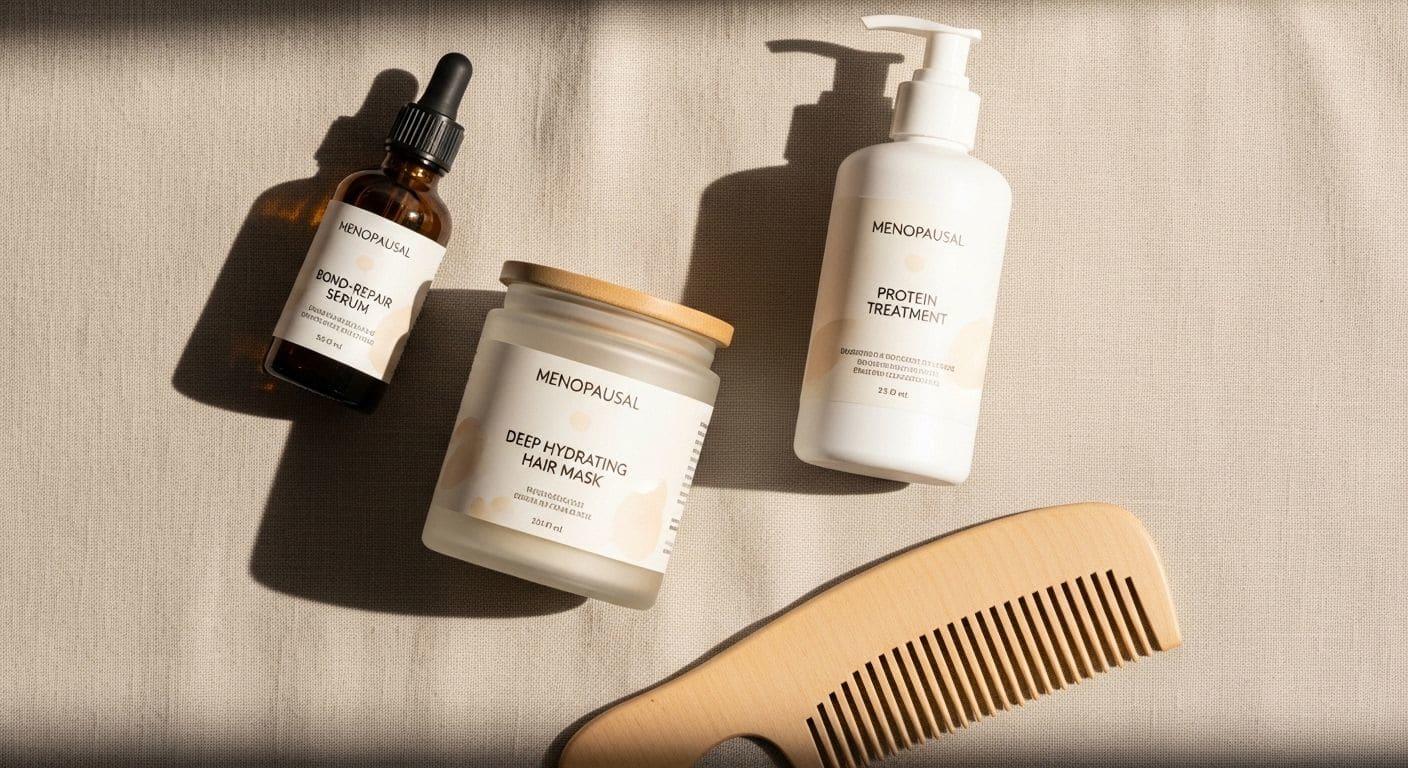
- Bond-repair treatments (e.g., Olaplex, K18): These work differently — they reconnect broken disulfide bonds inside the hair shaft rather than coating the outside. For hormonally weakened hair, these are often more beneficial than surface keratin smoothing.
- Ceramide and fatty acid-rich masks: Ceramides mimic the lipid structure that seals the cuticle. Weekly at-home masks containing ceramides, hyaluronic acid, and behentrimonium chloride address moisture retention without chemical processing risk.
Interestingly, the moisturising principles that work for menopausal hair translate directly to menopausal skin — the same lipid barrier logic applies. The guide to the best menopause face creams and skincare covers how ceramide and barrier-repair ingredients work across the skin — the same logic applies at the scalp.
Building a Practical Routine for Menopausal Frizz That Actually Holds
The contradiction between common belief and evidence here: most women with menopausal frizz reach for more heat styling to smooth it down — but heat accelerates the cuticle damage that worsens frizz long-term. Reducing heat dependency while building internal moisture is the approach that experienced trichologists and hormonal hair specialists consistently recommend.
A realistic routine looks like this: shampoo only 2-3 times per week using a sulphate-free formula (sulphates strip the limited sebum that menopausal scalps now produce less of). Follow with a protein-moisture balanced conditioner, not a heavy protein-only formula — over-proteinating fine menopausal hair makes it brittle and snappy rather than smooth. Apply a leave-in ceramide serum to damp hair before any heat. Use a microfibre towel to dry rather than rubbing with a standard towel, which disrupts the cuticle.
For those considering a keratin or smoothing treatment: do it on healthy hair, not already-damaged strands. Discuss your menopausal hair context with your stylist before booking — a professional should assess porosity, density, and existing damage before choosing the formulation. Done correctly and selectively, keratin smoothing is a useful tool in the menopausal hair toolkit. The goal is restoring structure, not masking ongoing damage.