
What the New Research Reveals About Why Frozen Shoulder Actually Happens
For decades, frozen shoulder was explained almost entirely through a mechanical lens: the shoulder gets immobilised, the capsule contracts, scar tissue forms. The treatment followed the same logic: stretch the scar tissue, move the joint. This model is incomplete. Research published since 2015 has identified a far more complex picture involving immune dysregulation, cytokine-driven inflammation, connective tissue fibrosis, and — increasingly — hormonal drivers, particularly in women.
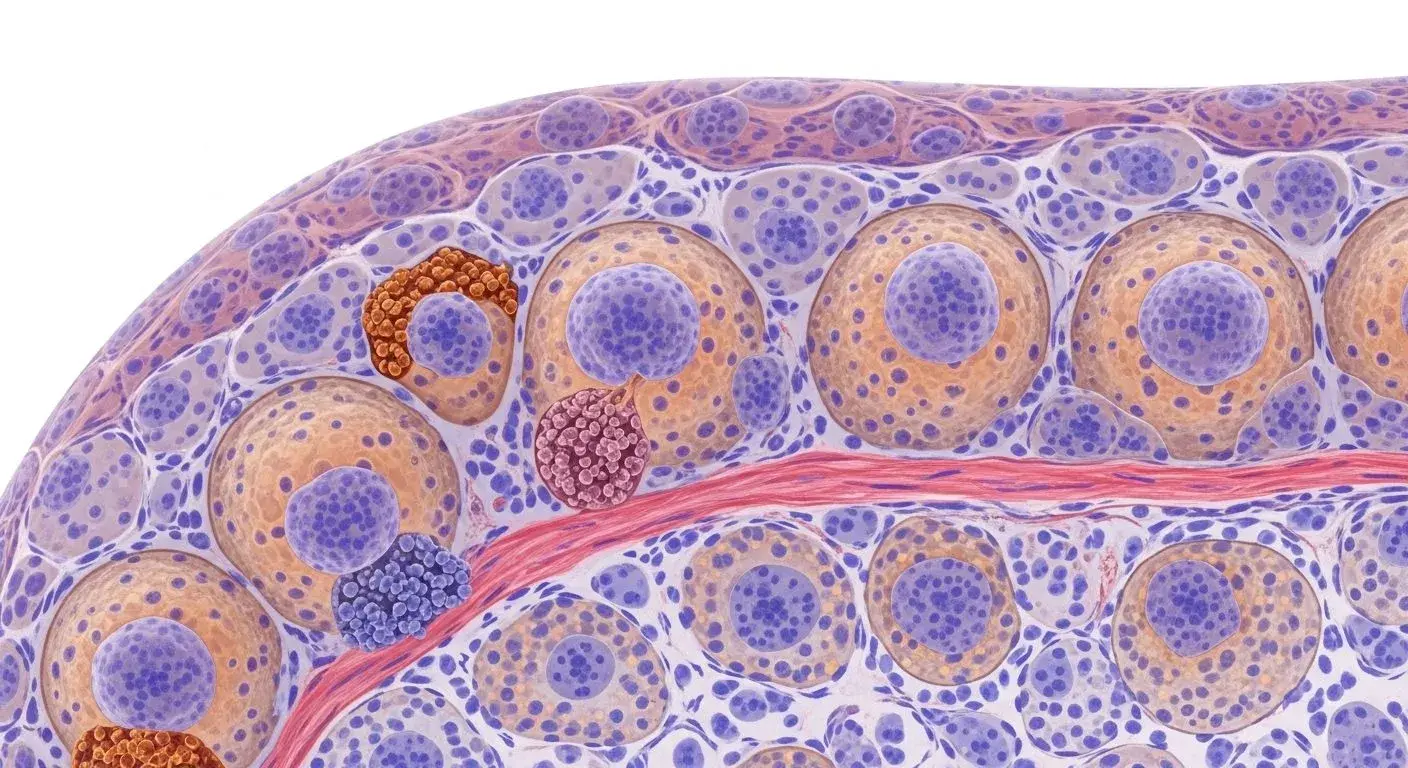
The frozen shoulder capsule is now understood to be in a state of active, ongoing inflammation and fibrosis — not simply passive scarring. Mast cells, macrophages, and fibroblasts are unusually active in the tissue of affected shoulders, producing collagen at a rate that outpaces normal remodelling. This is a biologically driven process, not purely a mechanical one. This distinction matters for treatment: if the underlying biology is not addressed, mechanical rehabilitation alone is often insufficient.
Most significantly, researchers have identified oestrogen receptors in the shoulder capsule. This finding means that the tissue responsible for frozen shoulder is directly responsive to hormonal signalling. When oestrogen levels fall during perimenopause, the capsule loses a key regulatory input — one that normally controls the balance between inflammation and tissue repair. Perimenopause body aches and joint pain and frozen shoulder now share a scientifically established hormonal root, not just a correlation.
What the New Science Changes About Frozen Shoulder Treatment
The emerging biological model has several important implications for how frozen shoulder should be managed — particularly for women in midlife.
- Earlier anti-inflammatory intervention: Because the condition is driven by active immune activity, early corticosteroid injections are now supported by stronger evidence than previously thought. Waiting months before intervening allows the fibrotic process to become more entrenched.
- Hormonal assessment as standard care: Given the oestrogen receptor finding, clinical researchers are arguing that perimenopausal and menopausal women presenting with frozen shoulder should have their hormonal status assessed as a routine part of evaluation — not as an afterthought.
- HRT as adjunct treatment: While randomised controlled trials are still underway, observational data and mechanistic plausibility support the use of HRT alongside physiotherapy in menopausal women with frozen shoulder. Several shoulder specialists now co-manage these patients with menopause clinics.
- Systemic disease investigation: Frozen shoulder is now understood as a systemic immune condition with local joint expression. All patients should be screened for diabetes, thyroid dysfunction, and cardiovascular risk — conditions that share the same inflammatory pathways.
One important limitation: the new science has advanced faster than clinical practice. Many GPs and even some orthopaedic surgeons are not yet integrating these findings into routine care. Advocating for a full metabolic and hormonal workup when presenting with frozen shoulder — especially during perimenopause — is both evidence-based and necessary. Back and hip pain during menopause and frozen shoulder are increasingly viewed as related manifestations of the same underlying hormonal and inflammatory shift.
Frequently Asked Questions
Is frozen shoulder a real medical condition?
Yes, frozen shoulder is a well-documented medical condition with a defined pathology. Capsular tissue in the affected shoulder shows measurable fibrosis, immune cell infiltration, and cytokine activity. It is not psychosomatic, not simply 'getting older,' and not a condition that needs to be tolerated without treatment.
What is the latest research on frozen shoulder?
Recent research has identified oestrogen receptors in the shoulder capsule, establishing a direct hormonal mechanism for why women are disproportionately affected. Studies also show that the condition involves active mast-cell and fibroblast activity — not simply passive scarring. This supports earlier, more aggressive anti-inflammatory treatment and hormonal assessment in perimenopausal women.
Does estrogen loss cause frozen shoulder?
The evidence strongly suggests oestrogen loss contributes to frozen shoulder risk. Oestrogen receptors have been found in shoulder capsule tissue, and the 40-to-60 female age group — the primary perimenopause cohort — is the most commonly affected demographic. Restoring oestrogen through HRT is being investigated as a treatment adjunct.
Why do women get frozen shoulder more than men?
Women develop frozen shoulder at approximately twice the rate of men. The most evidence-supported explanation is hormonal: oestrogen plays a direct role in regulating shoulder capsule tissue, and its decline during perimenopause creates a biological environment conducive to capsular fibrosis. Immune system differences between sexes may also contribute.
Sources
- Oestrogen Receptors in Adhesive Capsulitis: A Novel Finding. pubmed.ncbi.nlm.nih.gov — PubMed / NIH
- Immune Cell Activity in Frozen Shoulder Capsule Tissue. pubmed.ncbi.nlm.nih.gov — PubMed / NIH
- Adhesive Capsulitis: Pathophysiology and Emerging Treatment. mayoclinic.org — Mayo Clinic