
Why Menopause Causes Facial Hair — and Why It Tends to Get Worse Over Time
The sudden appearance of coarse hairs on the chin, jawline, or upper lip surprises many women entering perimenopause — but the biology behind it is straightforward. As oestrogen declines, it no longer counterbalances androgens (male hormones like testosterone) that all women naturally produce. The result is a relative androgen excess that stimulates facial hair follicles in a pattern called androgen-driven terminal hair growth. The effect usually begins in perimenopause and continues or intensifies after periods stop entirely.
Two common misconceptions here. First, many women believe the hair is 'just peach fuzz' that will resolve on its own — but unlike vellus hair, terminal chin and upper-lip hair is driven by hormone shifts that do not self-correct after menopause. Second, women often assume this only happens to those with naturally high testosterone. In reality, the trigger is the relative change in ratio, not an abnormally high androgen level. Women with perfectly normal testosterone readings still develop menopausal facial hair.
Interestingly, hormone disruption during this stage also triggers other skin and sensory changes — for example, rosacea flares linked to perimenopause and hormonal shifts are driven by the same underlying oestrogen withdrawal that worsens facial hair growth.
Does HRT Stop Facial Hair Growth — and What Actually Works for Removal?
The most searched question in this space is whether HRT will reverse the problem. The evidence-based answer: HRT can slow the progression of new facial hair, but it rarely eliminates hairs that have already converted to terminal growth. Oestrogen replacement rebalances the androgen ratio going forward — meaning women who start HRT early in perimenopause are less likely to see significant escalation. But established chin or upper-lip hair typically requires direct removal regardless of HRT status.
For removal itself, the options vary substantially in permanence and suitability for mature skin:
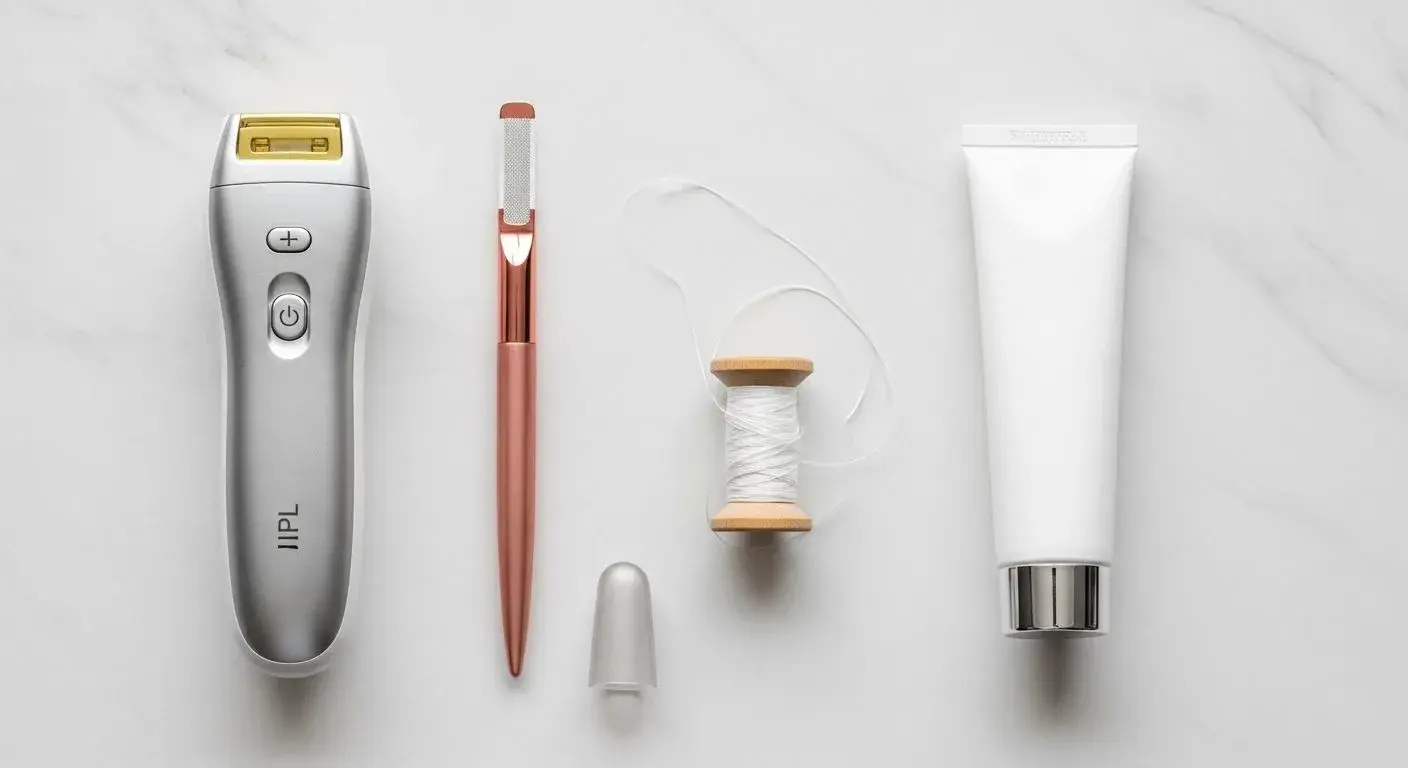
- At-home IPL devices: Effective for darker hair on lighter skin tones. Requires 6-8 sessions and maintenance. Not suitable for grey or white hairs — a key limitation for post-menopausal women, as facial hair often lightens with age.
- Eflornithine cream (Vaniqa): A prescription topical that slows regrowth by blocking an enzyme in hair follicles. Not a remover — works best combined with a physical method. Clinically shown to reduce regrowth speed in up to 58% of users after 24 weeks.
- Professional electrolysis: The only method clinically proven to permanently destroy follicles regardless of hair colour. Slower and more expensive, but the best long-term option for post-menopausal women with grey or white facial hair.
- Threading and dermaplaning: Temporary but gentle on thinning, sensitive menopausal skin. Threading avoids any contact with the skin surface — lower irritation risk than waxing, which can strip fragile skin.
A practical trade-off worth stating clearly: waxing is fast and accessible, but menopausal skin produces less collagen and is more prone to tearing and post-inflammatory pigmentation. Many dermatologists advise against hot waxing on facial skin in this life stage.
Will Menopausal Facial Hair Ever Go Away on Its Own — and When to See a Doctor
Honestly: no. Once oestrogen has declined and androgen-driven follicles have activated, that hair will not spontaneously resolve without intervention. Post-menopausal women often report that growth stabilises rather than accelerates after periods fully stop — but 'stabilising' is not the same as reversing. What actually changes is the rate of new follicle activation, not the existing ones.
There is also a case where standard advice fails: women on certain medications — including some blood pressure drugs and corticosteroids — can experience significantly accelerated facial hair growth that does not respond well to the usual hormonal explanations. If your facial hair growth feels sudden, excessive, or is accompanied by acne, voice changes, or irregular periods that do not fit typical menopause patterns, ask your GP to test for PCOS or an adrenal condition, even if you are in your 50s. These are underdiagnosed in the menopausal age group.
For holistic support during this transition, note that stress hormones (cortisol) can further elevate androgen activity — compounding facial hair. Similarly, the hormonal fluctuations that trigger facial hair are connected to broader skin sensitivity issues, such as itchy ears and skin irritation during menopause, which share the same root cause. Managing the hormonal environment holistically — through HRT, stress reduction, and targeted skincare — gives the best foundation before focusing on any individual removal method.