
Understanding Oestrogen's Role in Hair Growth
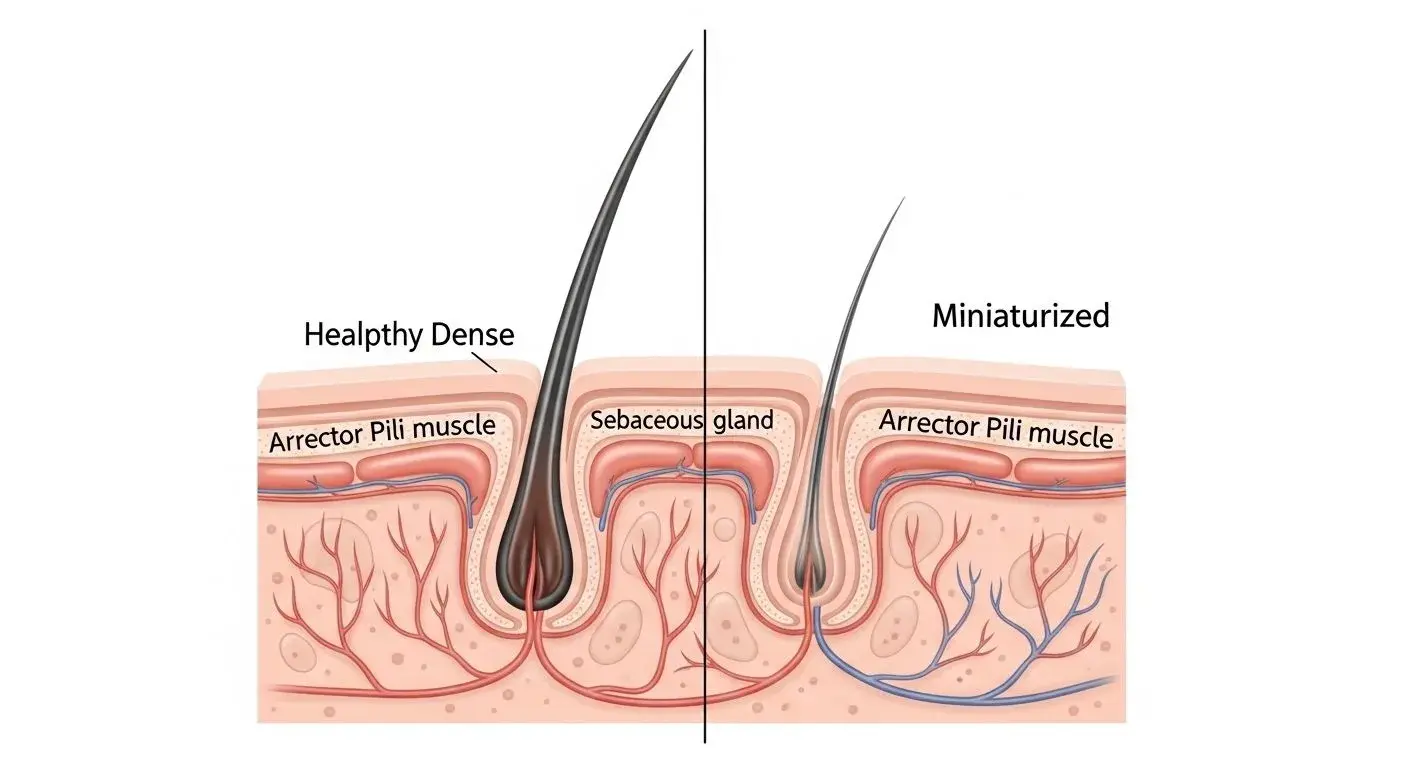
Hair loss during perimenopause is not coincidental — it is mechanistically tied to falling oestrogen. Oestrogen prolongs the anagen (active growth) phase of the hair cycle and suppresses androgens at the follicle level. When oestrogen declines, follicles spend less time growing and more time resting or shedding. At the same time, androgens — predominantly dihydrotestosterone (DHT) — become relatively dominant and begin to miniaturise follicles on the crown and along the parting, producing the diffuse thinning pattern most menopausal women describe.
This process is gradual, which is why many women do not connect it to hormones initially. Hair volume can decline by 30 to 40 percent before the change becomes visually obvious in photographs. The pattern is distinct from stress-related shedding (telogen effluvium), which causes sudden, diffuse loss across the whole scalp rather than the crown-and-parting thinning typical of hormonal follicle miniaturisation.
Scalp health compounds the picture. Oestrogen also supports the scalp skin barrier — so its decline can bring both thinning and a newly sensitive, itchy scalp simultaneously. For women experiencing both, the relationship between hormones and scalp condition is explored in detail in menopause itchy scalp: causes and relief.
Common Myths vs. What the Evidence Actually Shows
The most persistent myth is that taking oestrogen (via HRT) automatically reverses hair loss. Oestrogen does support the hair cycle, but HRT's effect on hair is inconsistent in practice. Women who begin HRT early in perimenopause often report stabilisation of shedding. Those who start post-menopause, once miniaturisation is already established, typically see little to no regrowth — the follicles most affected have already lost their structural capacity to produce full-diameter hair. HRT is better framed as a preventive tool than a restorative one for hair.
A second misconception: breakage and shedding are the same problem requiring the same solution. Breakage is structural — weakened hair snapping along the shaft due to dryness, heat damage, or mechanical stress. Shedding is follicular — hairs releasing from the root at the end of a shortened growth cycle. Treating breakage with biotin supplements (a common impulse) does nothing for true hormonal shedding. Treating shedding with deep conditioning masks addresses surface texture but not follicle biology.
The contradiction most worth knowing: biotin deficiency is genuinely rare in women eating a normal diet, yet biotin supplements dominate the hair loss supplement market. Iron deficiency and ferritin below 70 ng/mL, by contrast, are extremely common in perimenopausal women due to heavy irregular periods and directly suppress hair growth — yet far fewer women test for it. Low ferritin is one of the most treatable contributors to hormonal-era hair loss and the most consistently overlooked.
Practical Strategies That Work
The most evidence-supported topical treatment for hormonal hair thinning remains minoxidil — available as a 2% or 5% solution or foam for women. It extends the anagen phase and widens follicle diameter in miniaturised follicles. The critical experience detail: most women quit within 6 to 8 weeks due to an initial shedding surge (the telogen effluvium phase of treatment onset). This shedding is not hair loss — it is the scalp clearing resting hairs to make way for new anagen growth. Continuing through it is what determines whether the treatment works.
Beyond minoxidil, the internal factors matter enormously at this life stage. Ferritin should be above 70 ng/mL for optimal hair cycling — not just within the broad 'normal' lab reference range, which extends as low as 12. Protein intake is frequently inadequate in women over 45, and hair is essentially keratin — a protein structure. Targeting 1.2 to 1.6 grams of protein per kilogram of body weight daily supports both follicle function and the muscle changes of menopause simultaneously.
Some women find that targeted supplement regimens provide meaningful support. For context on how public figures have approached menopause management holistically, including supplement choices, Davina McCall's menopause supplement approach offers a useful real-world perspective.
Does Hair Grow Back After Menopause — and When Standard Advice Fails
The honest answer is: it depends on how far follicle miniaturisation has progressed. For women in early perimenopause with mostly intact follicles, stabilising hormones and treating deficiencies can produce visible regrowth within 6 to 12 months. For women post-menopause with years of untreated androgenic thinning, the follicles in affected zones may have undergone fibrosis — replaced by scar tissue — at which point neither topical nor systemic treatments can restore them. This is why early intervention genuinely changes outcomes.
Where standard advice consistently fails: women whose hair loss is driven by thyroid dysfunction rather than oestrogen decline. Hypothyroidism produces a pattern almost identical to hormonal thinning — diffuse loss, dull texture, slowed regrowth — and is significantly more common in perimenopausal women than in the general population. TSH testing is essential before committing to a hair loss treatment plan, because no amount of minoxidil or scalp serums will resolve shedding caused by undertreated thyroid disease.
The trade-off worth naming honestly: effective hormonal hair management requires patience measured in months, not weeks, and consistent daily commitment. Women who rotate between products every four to six weeks — a common pattern driven by frustration — never allow any single treatment to reach its efficacy window. Consistency with one evidence-based approach for a minimum of four months produces better outcomes than cycling through multiple options.