
What Perimenopause Actually Does to Your Face and Skin
Perimenopause skin changes are among the earliest and most visible signs that hormonal transition has begun — and they often start years before periods become irregular. The face is typically where changes appear first, because facial skin has a high concentration of estrogen receptors and is constantly exposed to environmental stressors that accelerate hormone-driven changes.
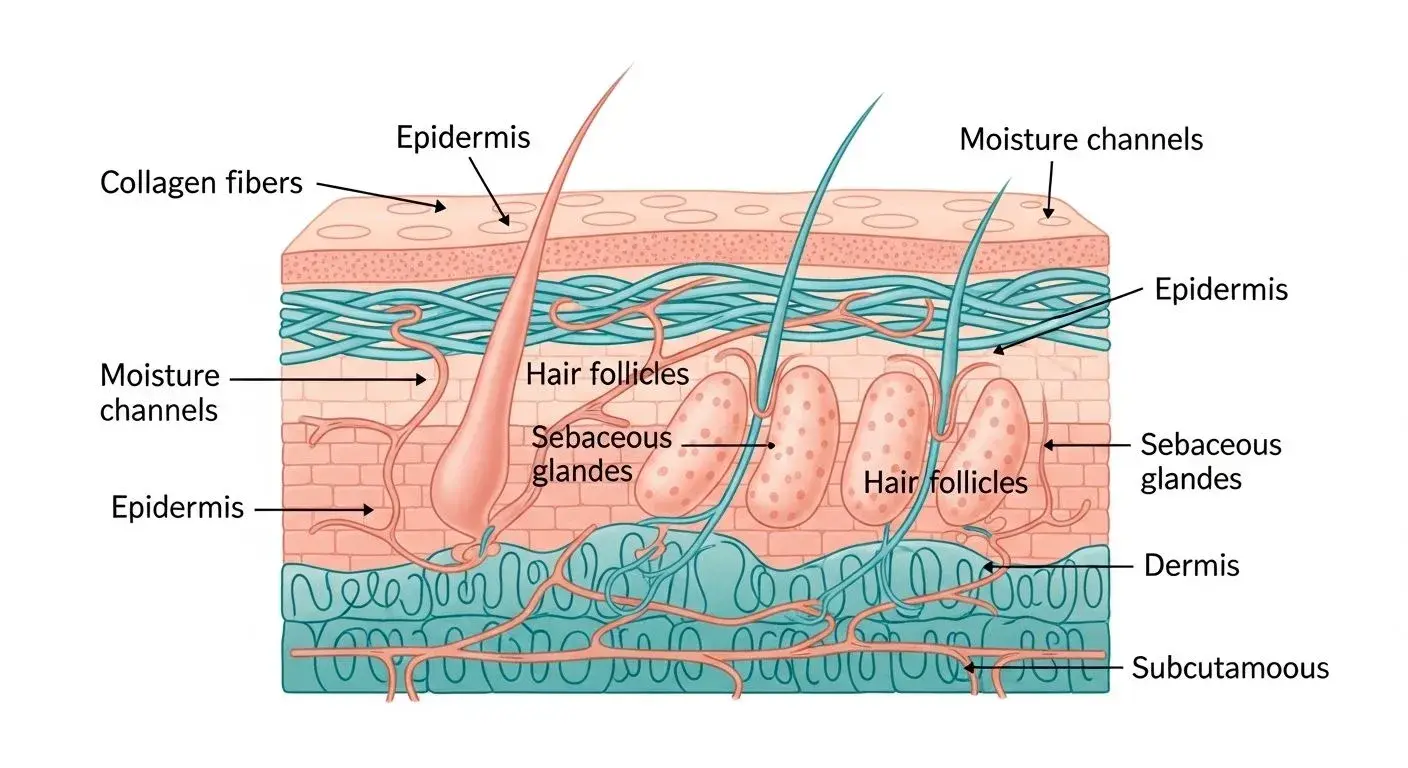
Estrogen has four key functions in skin: it stimulates collagen and elastin production, regulates sebum output, supports the skin's moisture-retention capacity, and modulates the inflammatory response. As estrogen begins its erratic decline in perimenopause, all four functions are disrupted simultaneously. This is why perimenopause skin can present in seemingly contradictory ways — drier on the cheeks but oilier on the chin, less firm overall but with new breakouts, more sensitive and reactive while also healing more slowly than before.
Progesterone also contributes. It falls earlier and more steeply than estrogen in most women, reducing the anti-inflammatory buffering that keeps skin calm. Women who had no issues with inflammatory skin conditions in their 30s frequently develop rosacea flares, contact sensitivities, and redness patterns in their mid-40s without any change to their diet, environment, or products. The trigger is internal, not external.
Common Perimenopause Skin Conditions — and What Distinguishes Them
Understanding which specific perimenopause skin conditions you are dealing with matters because treatments differ significantly. Several conditions cluster in perimenopause and are often conflated:
- Loss of facial volume and structure: Collagen decline leads to a flattening of the midface, deepening of the nasolabial folds, and a less defined jawline. This is structural, not a surface skincare issue — topical retinoids and peptides can slow the rate of collagen loss but cannot fully replace what has already gone.
- Hormonal pigmentation changes: Melasma and post-inflammatory hyperpigmentation both worsen in perimenopause. Paradoxically, some women who had melasma during pregnancy find it worsens again as hormones fluctuate. Vitamin C, niacinamide, and consistent SPF are the most evidence-supported management tools.
- Adult-onset acne: The relative rise of androgens as estrogen falls causes sebaceous glands to become more active, particularly along the chin and jawline. This is often mistaken for teenage-type acne and treated with drying products that worsen the barrier damage already present.
- Rosacea and persistent facial redness: One of the most under-recognised perimenopause skin conditions. Vasomotor instability from hot flashes, combined with reduced barrier function, makes rosacea both more likely to develop and harder to manage. Our detailed guide on rosacea in perimenopause and hormonal treatment covers the specific management approach this requires.
A common misconception is that all of these perimenopause face changes are inevitable and unresponsive to intervention. In practice, evidence supports that HRT slows collagen loss and reduces vasomotor flushing, that retinoids significantly improve skin texture and pigmentation when tolerated, and that a barrier-focused routine reduces reactivity and sensitivity over time. None of these reverse the transition, but they change its visible trajectory meaningfully.
What Changes Across the Perimenopause Transition — and When to Act
Perimenopause skin does not change in a linear way. Early perimenopause (typically mid-40s, with regular but sometimes variable cycles) tends to produce reactive, fluctuating skin — one week dry, one week congested, with unpredictable flushing or sensitivity. This is the phase where product tolerability often changes abruptly, and routines that worked for years suddenly cause irritation.
Late perimenopause and early post-menopause produces more consistent but more pronounced changes: marked dryness, increased laxity, slower wound healing, and more persistent pigmentation. Vitamin C becomes especially useful here — both for its collagen-cofactor role and its ability to address the sun damage that accumulates faster on thinned, estrogen-depleted skin. Evidence for topical vitamin C at concentrations of 10 to 20% L-ascorbic acid is well-established; our article on using vitamin C on your face before and after results shows what realistic outcomes look like for this age group.
Where standard advice fails is in treating perimenopause skin as a singular problem with a singular solution. The reality is a layered picture: hormonal management (HRT where appropriate), barrier repair as a daily non-negotiable, targeted actives for specific concerns, and a realistic timeline measured in months rather than weeks. Women who approach it this way consistently see meaningful results. Those expecting a single cream to address estrogen-driven structural skin change will be disappointed — not because the products are ineffective, but because the expectation does not match the biology.