
Can Low Progesterone Cause Hair Loss in Women?
Yes — but not directly in the way most women assume. Progesterone does not feed hair follicles the way nutrients do. Its relationship with hair loss works through two separate pathways, and understanding both explains why some women respond well to progesterone support while others do not.
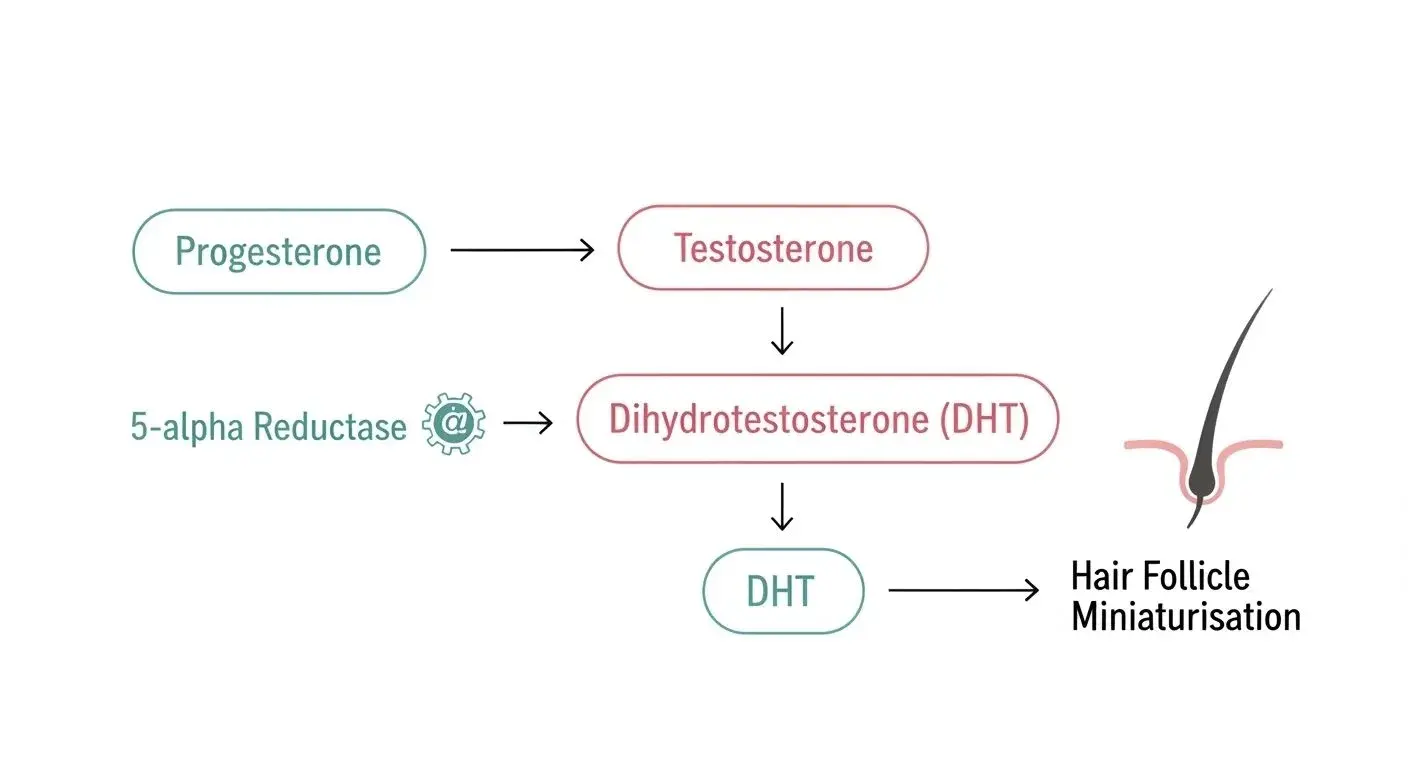
Pathway 1 — DHT competition: Progesterone inhibits 5-alpha reductase, the enzyme that converts testosterone into dihydrotestosterone (DHT). DHT is the primary androgen that miniaturises hair follicles in genetically susceptible women. When progesterone falls — as it does sharply in perimenopause — this natural brake on DHT weakens, and follicle miniaturisation can accelerate.
Pathway 2 — cortisol buffering: Progesterone competes with cortisol at receptor sites. Low progesterone means cortisol's effect on the body is amplified, and chronically elevated cortisol is a known trigger of telogen effluvium (diffuse shedding). This is the overlooked connection that explains why perimenopausal women experiencing high stress often notice disproportionate shedding.
One misconception worth addressing: low progesterone is often blamed as a standalone cause, but it rarely acts alone. In practice, progesterone decline coincides with rising androgen sensitivity and falling oestrogen — it is the combination that determines whether significant hair loss occurs. Testing progesterone in isolation gives an incomplete picture. For a broader view of how hormonal changes affect the scalp, see our guide on menopause-related itchy scalp causes and relief, which covers follicle inflammation driven by the same hormonal shifts.
Does Progesterone Actually Help With Hair Loss?
This is where the evidence becomes more nuanced — and where the form of progesterone matters enormously. There is an important distinction between synthetic progestins (used in many oral contraceptives and older HRT formulations) and bioidentical progesterone.
Bioidentical progesterone: Oral micronised progesterone (such as Utrogestan) and progesterone-based topical creams are structurally identical to the hormone the ovaries produce. These forms retain the 5-alpha reductase inhibiting effect and are generally considered hair-neutral to mildly protective.
Synthetic progestins: Several synthetic progestins — particularly levonorgestrel and norethisterone — have androgenic activity of their own and can actively worsen hair loss in susceptible women. This is the critical contradiction: taking 'progesterone' in the wrong form can accelerate the very problem you are trying to solve. Women on combined HRT who notice increased shedding should ask their prescriber specifically about the progestogen component.
Topical progesterone cream applied directly to the scalp has been studied in small trials with modest positive results for hair density, but evidence remains limited. It should not be considered a primary treatment. As a supportive measure alongside addressing other hormonal drivers — particularly if bruising and skin fragility are also present, which often signal the same progesterone-oestrogen imbalance — it may have a role. You can read more about how this same hormonal pattern affects connective tissue in our article on menopause bruising causes and prevention.
What to Do If You Suspect Low Progesterone Is Affecting Your Hair
The most practical starting point is not a progesterone supplement — it is a hormone panel. A single serum progesterone result is only meaningful when tested at the right point in your cycle (day 21 in a 28-day cycle, or 7 days before expected period). Outside that window, low results are expected and meaningless.
If you are perimenopausal, progesterone levels fluctuate unpredictably, and a single test may not capture the full picture. A more informative approach is tracking cycle changes: shortening cycles, heavier periods, and worsening PMS alongside hair shedding are together a stronger clinical signal than any single blood result.
Where the standard advice of 'just take progesterone cream' fails: women with underlying androgenetic alopecia need direct anti-androgen intervention (such as spironolactone or topical minoxidil), not progesterone alone. Progesterone can reduce DHT conversion modestly, but it is not a substitute for targeted treatment in women with significant pattern hair loss. Think of it as supportive — not curative.
The key trade-off: correcting progesterone levels through HRT or supplementation may benefit hair but requires careful selection of the progestogen type, ideally with a menopause specialist rather than a general practitioner. The wrong formulation is a common and preventable cause of worsening hair loss in women who believe they are treating it.