
Why Most Foundations Claim Smoothing But Make Texture Worse
The term skin smoothing foundation appears on hundreds of products, yet most create the opposite effect on actual human skin with pores, lines, and texture irregularities. The disconnect stems from how formulas are tested—on professional models with already-smooth skin under controlled lighting—versus how they perform on real skin experiencing enlarged pores, acne scarring, fine lines, or roughness from dehydration. A foundation can create flawless coverage on perfect skin while simultaneously settling into every imperfection on textured skin, yet both scenarios allow brands to claim smoothing properties.
What dermatologists and cosmetic chemists understand that marketing ignores: genuine texture smoothing requires three simultaneous mechanisms that most foundations lack. First, optical diffusers—typically synthetic fluorphlogopite, boron nitride, or specialized mica—that scatter light away from texture variations rather than allowing shadows to form in pores and lines. Second, film-forming polymers that create a flexible mesh across skin's surface, physically spanning small imperfections without settling into them. Third, balanced slip properties that allow the foundation to glide across raised areas and depressions equally, preventing product buildup in valleys while maintaining coverage on peaks.
The most damaging misconception is that smooth foundation makeup means thick, heavy coverage that physically fills imperfections. This Instagram-era thinking leads women toward full-coverage formulas that look smooth in selfies but separate from skin in person, creating a mask-like appearance where you can see the line between foundation and natural skin. True smoothing foundations work by altering how light interacts with your existing texture, not by creating an artificial surface layer. They make your skin appear smooth through optical illusion while maintaining a skin-like quality that moves naturally with facial expressions.
The Science Behind Optical Smoothing vs. Physical Filling
Professional makeup artists distinguish between two fundamentally different approaches to creating smooth-looking skin. Physical smoothing uses silicone-based primers and foundations with suspended silica spheres that temporarily fill pores and fine lines—this works for photography and short-term wear but breaks down with natural facial oil production, skin movement, and time. Within 3-4 hours, these formulas typically settle into the very imperfections they initially concealed, often looking worse than wearing no foundation at all.
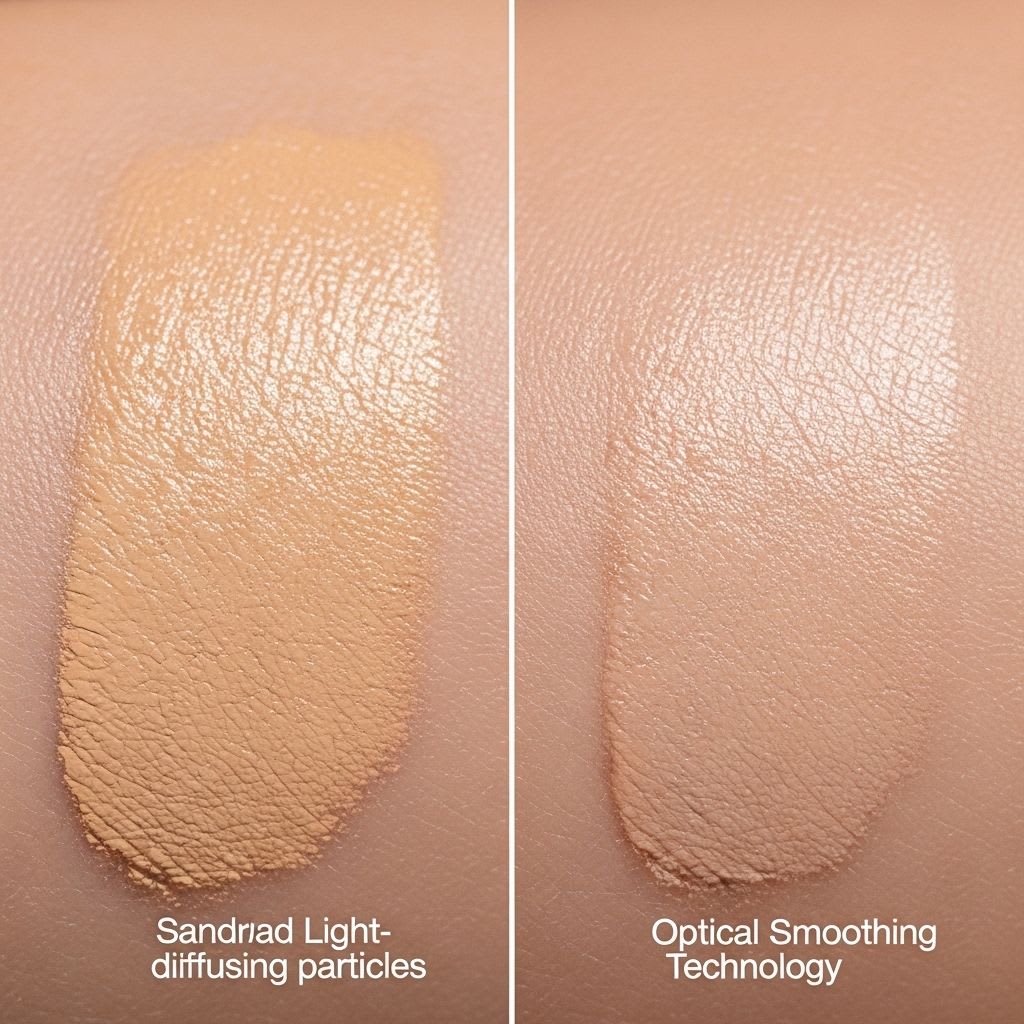
Optical smoothing, conversely, employs light-diffusing technology that remains effective regardless of wear time because it doesn't rely on physical filling. These foundations contain micro-fine particles with specific refractive indices that bend and scatter light as it hits skin's surface. When light encounters a pore or wrinkle, instead of creating a defining shadow, it disperses in multiple directions, softening the appearance of the imperfection. This is why certain foundations can make pores appear smaller in person without actually filling them—your eyes perceive smoothness because the usual shadow patterns that define texture aren't forming. The best smoothing foundation formulas combine both approaches: silicone-based slip for initial application perfection, plus optical diffusers for sustained smoothing throughout wear.
Ingredients and Technologies That Actually Smooth Texture
The ingredient list reveals whether a foundation genuinely smooths or merely claims to. Dimethicone and cyclopentasiloxane create the silky slip that allows foundation to glide across textured skin without catching on rough patches or settling into pores during application. These volatile silicones evaporate partially after application, leaving a thin, breathable film that maintains smoothness without feeling heavy. Critics cite these as pore-clogging, but research consistently shows properly formulated silicones are non-comedogenic—the issue is typically other ingredients or inadequate cleansing, not the silicones themselves.
For genuine optical diffusion, look for synthetic fluorphlogopite, calcium sodium borosilicate, or diamond powder in the first ten ingredients. These create the soft-focus blur that professional photographers previously achieved only with special lenses. Polymethyl methacrylate (PMMA) spheres provide additional texture blurring by filling microscopic surface irregularities while reflecting light diffusely. The trade-off: foundations rich in optical diffusers can look slightly chalky or create a subtle white cast in flash photography—they're optimized for how you look in person, not for selfies with harsh LED flash that reveals the light-scattering particles.
- Nylon-12: Absorbs excess oil while creating a soft, velvety texture that blurs pores without emphasizing dryness
- Silica (spherical): Provides mattifying properties and fills fine lines temporarily while diffusing light to soften their appearance
- Bismuth Oxychloride: Creates luminous smoothing through light reflection, though can irritate sensitive skin in high concentrations
- Avoid: Talc as a primary ingredient: While safe, it can emphasize dry patches and lacks the advanced texture-smoothing of modern synthetic alternatives
The application method dramatically impacts smoothing performance. Damp beauty sponges work best for smoothing foundations because they deposit product in a thin, even layer that conforms to skin's contours rather than sitting on top. Stippling or bouncing motions prevent dragging across texture that can emphasize irregularities. Brushes can work but require dense, synthetic bristles that press product into skin rather than buffing across the surface. For mature skin experiencing multiple texture concerns, explore our guide to foundations specifically formulated for aging skin texture that addresses pores, wrinkles, and dryness simultaneously.
When Smoothing Foundation Recommendations Actually Fail
The universal recommendation to use pore-filling primers under smoothing foundations backfires for approximately 40% of users with combination or oily skin. Layering silicone-heavy primer under silicone-based foundation creates a slippery surface where the foundation can't properly adhere, leading to separation, pilling, and foundation that slides off entirely within hours. If you have normal-to-oily skin, choose one or the other—either a smoothing primer with minimal foundation, or a smoothing foundation applied directly to moisturized skin. For dry or mature skin that can handle both, wait a full five minutes between primer and foundation application to allow the primer to set properly.
Another scenario where standard advice fails: assuming all skin texture benefits equally from smoothing formulas. Active acne requires foundations that won't exacerbate breakouts—many smoothing foundations contain comedogenic ingredients that work beautifully on scarring or aging skin but worsen active inflammation. Textured skin from eczema or rosacea often reacts to optical diffusers, particularly bismuth oxychloride, which can trigger flares despite creating beautiful smoothing on uncompromised skin. The best skin smoothing foundation for your specific texture type requires matching the cause of texture to the formula's mechanism—physical filling for static concerns like scars, optical diffusion for dynamic concerns like fine lines that move with expression.
The critical contradiction between marketing promises and reality: foundations claiming to blur pores and wrinkles often create opposing effects depending on skin type and age. A formula optimized to blur large pores through oil absorption will emphasize fine lines on dry, mature skin by removing essential moisture. Conversely, a foundation engineered to fill wrinkles through heavy emollients can make pores appear larger by introducing excess oil to already-oily skin. This is why single-product solutions rarely work across multiple texture types—you may need different foundations for different areas of your face, using a pore-blurring formula on your T-zone and a line-smoothing formula on your cheeks and around your eyes.
The smoothing foundation paradox that few acknowledge: formulas that create the most dramatic texture improvement in photos often look obviously artificial in person, particularly in natural daylight. Heavy optical diffusers can create a subtle white or gray cast on deeper skin tones, while excessive light-scattering particles produce a flat, dimensionless appearance that reads as filtered rather than naturally smooth. The foundations that look most convincingly smooth in real life typically have moderate rather than extreme smoothing technology, maintaining enough natural skin texture to appear authentic while softening imperfections to flattering levels. Test smoothing foundations in multiple lighting conditions—indoor, outdoor, natural, and artificial—before committing.
For comprehensive guidance on adapting your entire makeup approach to achieve smooth, natural-looking results across all skin changes, see our complete makeup guide for hormonal skin transitions that addresses texture management holistically rather than through foundation alone.