
Yes, Menopause Can Cause Acne — Here Is Why
Acne during or after menopause surprises many women precisely because the conventional wisdom links breakouts with high oestrogen (as in teenage puberty) rather than low oestrogen. The reality is more nuanced. Perimenopausal acne is driven not by the absolute level of any single hormone, but by a shift in the androgen-to-oestrogen ratio. As oestrogen declines, androgens — including testosterone and DHEA — become relatively unopposed. These androgens directly stimulate sebaceous glands, increasing sebum production and creating the ideal environment for Cutibacterium acnes (the bacteria associated with inflammatory acne) to proliferate.
There is an important pattern difference from teenage acne: menopausal breakouts tend to cluster along the lower face — jawline, chin, and neck — rather than the forehead and nose. They also tend to be deeper, more cyst-like, and slower to resolve. This is hormonal acne in its most classic distribution. Women who had clear skin in their 20s and 30s are often the most caught off guard, because nothing in their history prepared them for it.
A common misconception worth addressing early: many women assume breakouts signal 'high androgens' and try supplements marketed to lower testosterone. In perimenopause, the issue is rarely absolute androgen excess — it is relative dominance due to falling oestrogen. Treatments that target oestrogen restoration or androgen receptor activity at the skin level are more effective than general 'testosterone-lowering' protocols. For the specific oily skin mechanisms behind perimenopausal breakouts, our guide on greasy skin during perimenopause and menopause covers the sebum side of the picture in detail.
What Works — and Where Standard Acne Advice Fails
The biggest failure point for women treating menopausal acne is following advice designed for teenage skin. Teenage acne responds well to aggressive drying and high-concentration benzoyl peroxide because the skin has high oil reserves and robust barrier repair capacity. Perimenopausal skin does not. Applying strong acne treatments to skin that is already experiencing barrier compromise leads to the classic 'dry and broken out' outcome — dehydrated patches coexisting with inflamed spots.
Evidence-supported approaches for this specific skin stage:
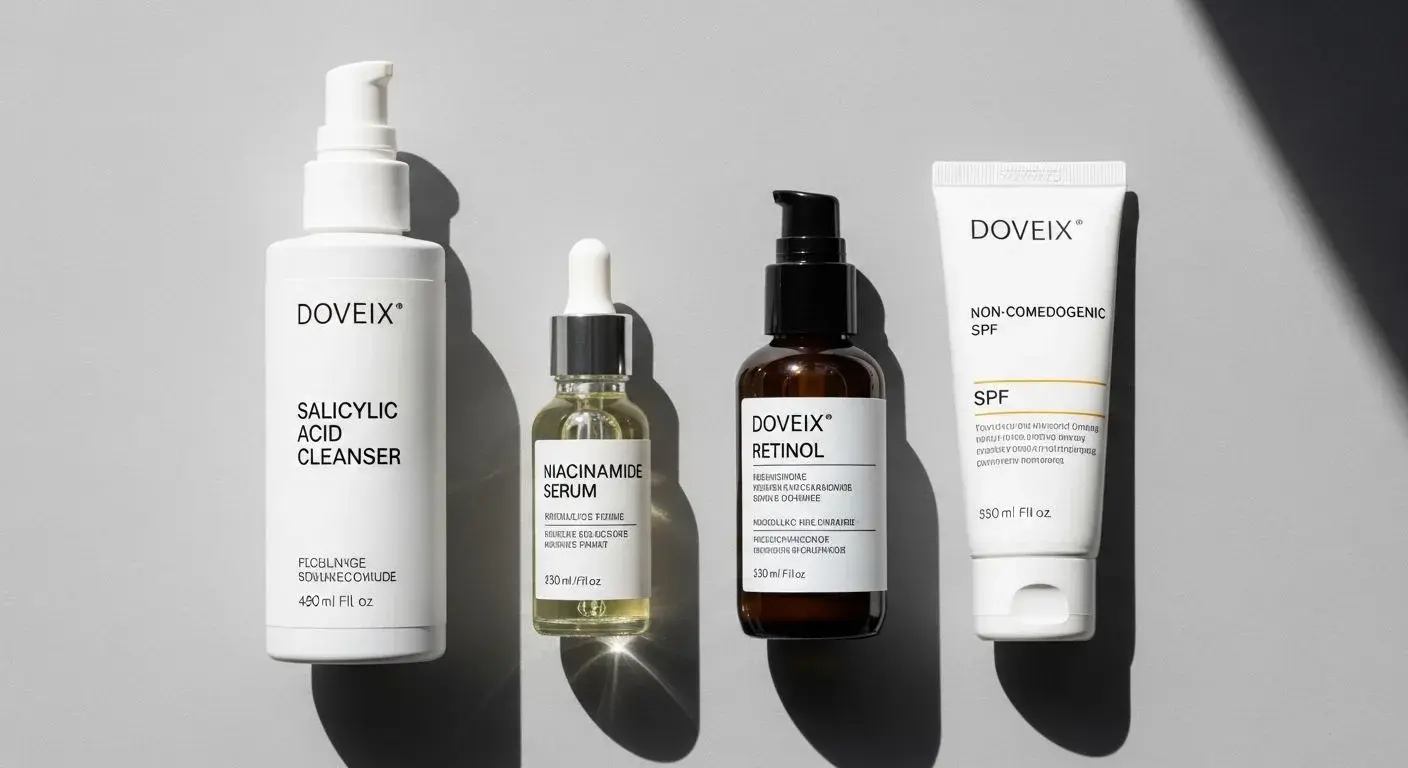
- Low-dose retinoids: Tretinoin 0.025% or over-the-counter retinol reduces sebum, normalises cell turnover, and prevents follicular plugging. More effective long-term than most over-the-counter spot treatments.
- Niacinamide 5–10%: Regulates sebum output and reduces inflammatory redness without stripping the barrier. A reliable daily-use active that does not worsen dryness.
- Azelaic acid (10–15%): Antibacterial, mildly anti-inflammatory, and effective against post-inflammatory hyperpigmentation — the dark marks breakouts leave on mature skin which fade much more slowly than they did at 25.
- Oral spironolactone (prescription): An anti-androgen that reduces sebum at the source. Often highly effective for jawline and chin acne when topicals are insufficient. Worth discussing with a GP or dermatologist.
One trade-off that is often underdisclosed: retinoids — while effective — initially cause a 'purge' period of 4–6 weeks in some women where breakouts appear to worsen. This is a normal process of accelerated cell turnover, not an allergic reaction. Starting retinol once a week and increasing gradually over two months avoids the most intense version of this. Women who give up at week three often miss the improvement that starts at weeks six to eight.
Acne as a Sign of Menopause: What Else to Watch For
Acne alone is rarely the first sign that perimenopause has begun, but it often appears alongside other skin changes that collectively point to the hormonal transition: increased oiliness in the T-zone, skin that seems more reactive or 'thin-feeling', and a new tendency to flush. When multiple of these coincide in the late 30s or 40s — especially alongside irregular cycles — it is worth treating them as a connected hormonal picture rather than isolated skin problems.
Post-menopausal acne (after periods have stopped for 12+ months) follows a slightly different pattern. Sebum levels typically drop in true post-menopause, so severe cystic acne is less common. However, slower cell turnover, reduced barrier function, and impaired wound healing mean that even moderate breakouts leave more lasting marks and take longer to resolve. The priority in this stage shifts from sebum control toward gentle exfoliation and post-inflammatory hyperpigmentation treatment.
It is also worth knowing that rosacea — a condition characterised by persistent facial redness and visible capillaries — is frequently mistaken for acne during perimenopause, and vice versa. The two can coexist, but they require completely different treatment approaches. Using acne-specific actives on rosacea-affected skin can cause significant flares. If you are unsure which condition you are dealing with, our resource on rosacea during perimenopause and hormonal treatment options can help clarify the distinction and guide next steps.