
How Estrogen Shapes Your Face — and What Changes When It Drops
Estrogen does not just regulate the reproductive system. It is one of the primary drivers of skin structure and function throughout a woman's life. Estrogen receptors sit in the dermis, the epidermis, and in sebaceous glands, meaning that when estrogen declines during perimenopause and menopause, the effects on facial skin are direct and measurable — not simply a side effect of 'getting older'.
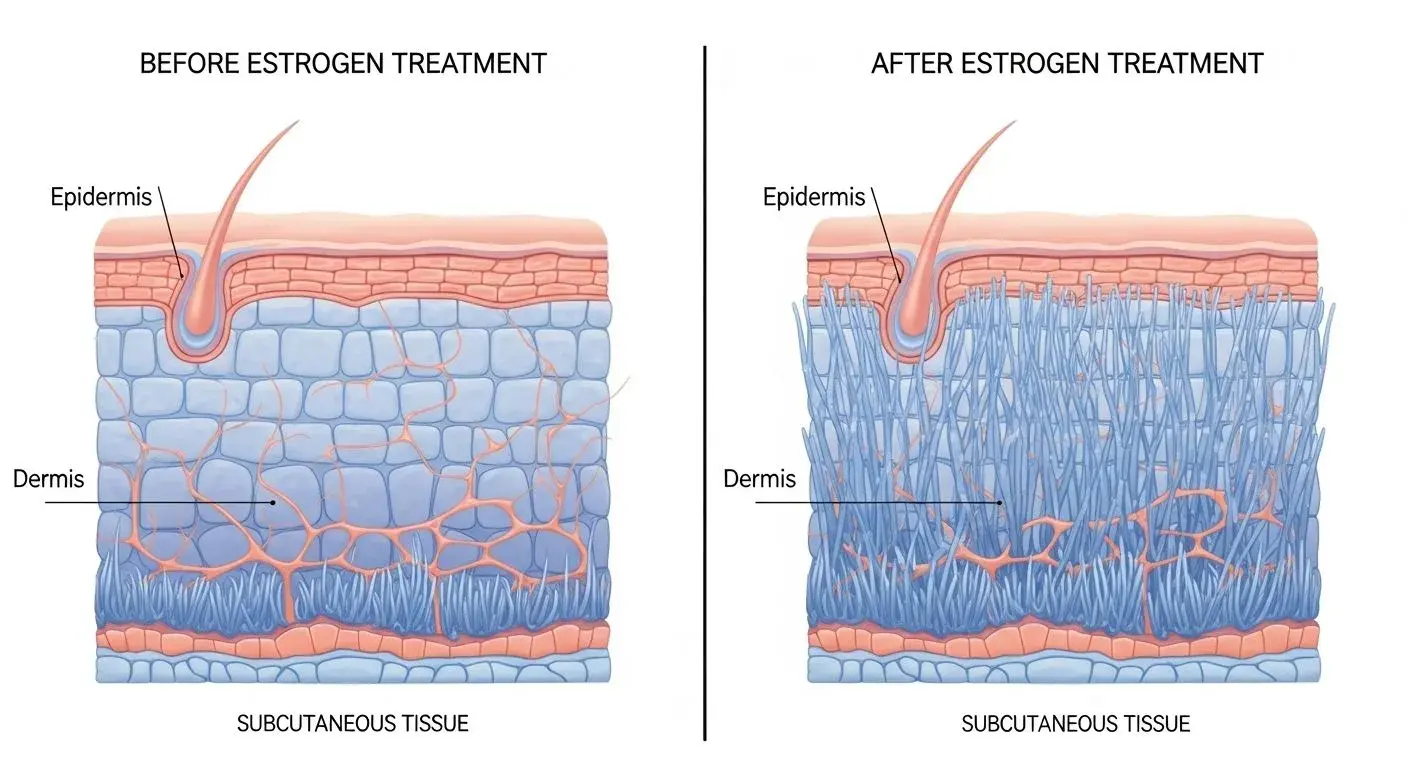
Specifically, estrogen stimulates collagen production (primarily type I and III), supports hyaluronic acid synthesis for skin hydration, maintains sebum output which keeps the skin barrier intact, and regulates wound healing speed. When estrogen falls, women typically lose collagen at an accelerated rate — studies suggest up to 30% of skin collagen is lost in the first five years after menopause. The visible result is accelerated thinning, increased laxity, dryness, and deeper lines — particularly around the jaw, under the eyes, and at the mouth.
Hormone replacement therapy (HRT) replaces the estrogen that the ovaries are no longer producing. Logically, this should reverse some skin changes — and the evidence supports that it partially does. Clinical studies consistently show that women on systemic estrogen HRT have measurably better skin thickness, hydration, and elasticity than age-matched peers who are not on HRT. The face, being richly vascular and highly responsive to hormonal signals, tends to show some of the clearest improvements.
What HRT Face Changes Actually Look Like — Realistic Timelines and Limits
Women starting HRT often ask how quickly they will see results in their face. The honest answer is: meaningful skin changes take longer than most expect. Improved hydration can be noticeable within four to six weeks as the skin barrier strengthens and moisture retention improves. Visible changes in firmness and reduction of fine lines typically take three to six months, because collagen synthesis is a slow biological process. Deeper structural changes — like improved jawline definition or reduced sagging — require consistent HRT use over a year or more, and results vary considerably by age at initiation.
The most common misconception is that HRT will reverse facial aging comprehensively. It will not. HRT preserves and modestly improves what is present at the time of starting, but it cannot fully restore collagen that was lost during years of estrogen deficiency before treatment began. Women who start HRT in early perimenopause typically see better facial outcomes than those who begin a decade post-menopause, because the preservation effect is stronger than the restoration effect.
A second misconception: that all HRT formulations produce identical skin results. Transdermal estrogen (patches, gels, sprays) delivers estrogen more steadily and is generally considered better for skin outcomes than oral estrogen, which undergoes liver metabolism that can alter hormone levels unpredictably. Progesterone type also matters — micronised progesterone appears more skin-neutral than synthetic progestins, which in some women trigger breakouts or increase skin sensitivity.
If redness and flushing are part of your skin picture alongside these changes, it is worth understanding whether rosacea is co-occurring — the two conditions are frequently confused in perimenopause. Our article on rosacea in perimenopause and hormonal treatment covers how to distinguish hormonally-driven flushing from true rosacea, which requires separate management.
Maximising HRT Skin Benefits — and When It Is Not Enough on Its Own
HRT provides the hormonal foundation, but it is not a standalone skincare strategy. Women who see the best facial outcomes on HRT typically combine it with actives that work through independent mechanisms: retinoids (which directly stimulate fibroblasts to produce collagen), peptides (which signal skin repair pathways), and broad-spectrum SPF (which prevents ongoing UV-driven collagen degradation). Sun damage continues regardless of estrogen levels, and HRT cannot counteract it.
The case where HRT alone notably falls short is in women with significant photoageing before starting treatment. In this group, the structural damage from decades of UV exposure is largely independent of estrogen, and skin improvement from HRT will be modest at best. Combination approaches — including in-clinic treatments like microneedling or resurfacing — tend to produce more meaningful results than HRT alone for this profile.
For building a daily skincare routine that complements HRT, formulation matters enormously. Products designed for menopausal skin address barrier function, hydration depth, and collagen support simultaneously. Our guide to the best menopause face cream and skincare covers what to look for in each product category to support — and not undermine — the skin improvements HRT can deliver.