
The Hormonal Reason Your Skin Itches Around Your Period
If your skin becomes itchy, prickly, or hyper-sensitive in the days before or during your period, you are experiencing a well-established but poorly communicated phenomenon: cyclical hormonal pruritus. It is not a coincidence, and it is not in your head. The hormonal fluctuations of the menstrual cycle directly affect skin barrier function, inflammation thresholds, and nerve sensitivity.
In the luteal phase — the week or so before your period begins — oestrogen and progesterone both drop sharply. Oestrogen, in particular, plays a key role in maintaining the skin barrier and regulating ceramide production. When it falls, the skin temporarily loses moisture more quickly and becomes more reactive. Simultaneously, prostaglandins (inflammatory compounds that trigger uterine contractions) are released in higher concentrations and can also sensitise skin nerve fibres, lowering the itch threshold across the body.
A common misconception is that period-related skin changes only mean breakouts. Itch, flushing, heightened sensitivity to products, and even hive-like reactions are all documented cyclical skin events. Another misconception: many women assume the itching is caused by their sanitary products. While that can be a separate issue, the itch that appears across the arms, legs, torso, or face is systemic — not contact-based. The two need to be distinguished because the solutions are completely different.
This same hormonal mechanism — oestrogen regulating skin barrier integrity — is also what drives itching in perimenopause and menopause, just on a permanent rather than cyclical scale. menopause and perimenopause itching: causes and treatment explains how this progresses for women entering the menopause transition, particularly for those whose menstrual itch has been worsening cycle by cycle.
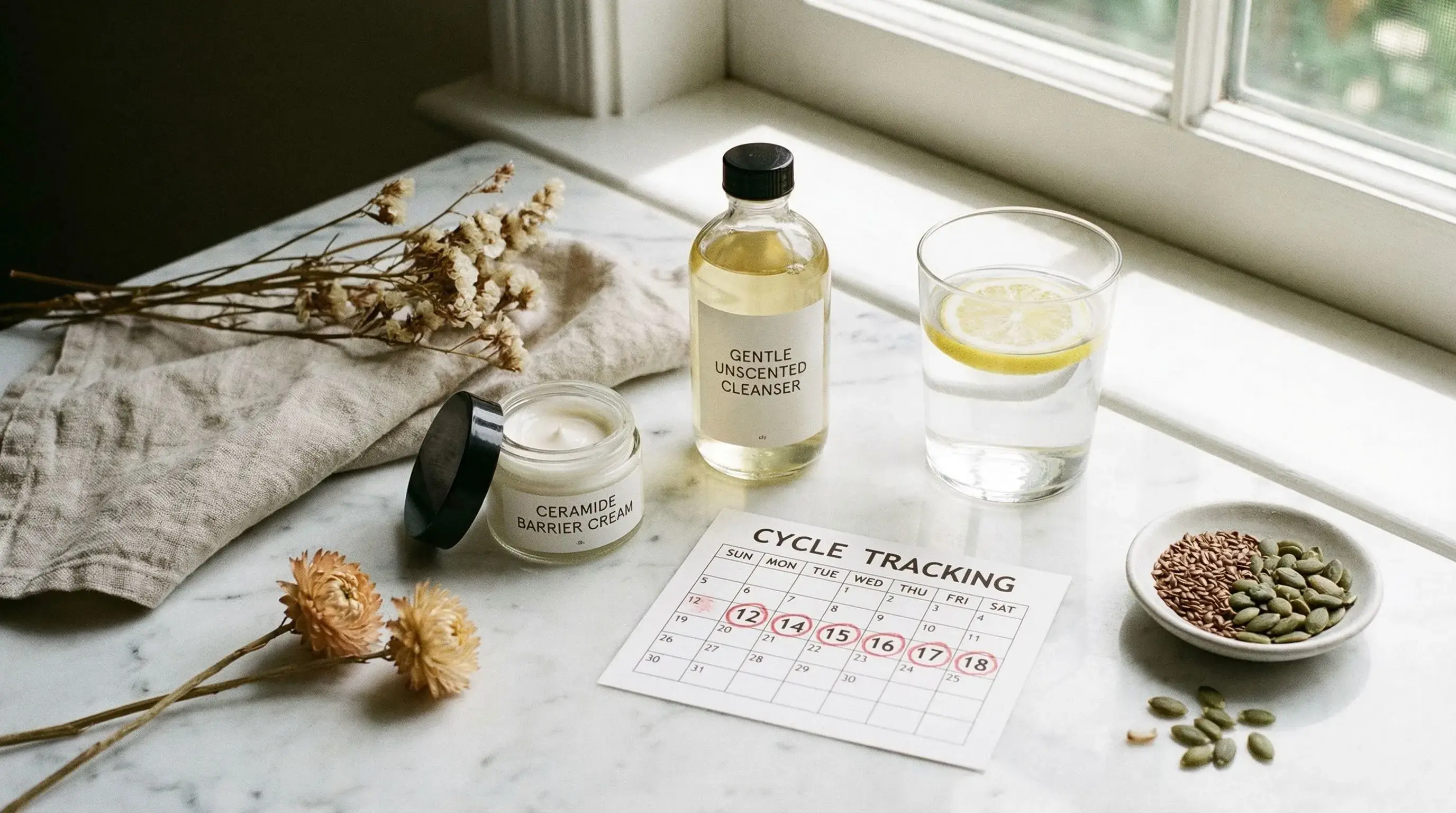
Conditions That Make Period Itching Worse
For some women, the cyclical drop in oestrogen is enough on its own to trigger noticeable itching. For others, the hormonal shift acts as the trigger that pushes an already-sensitised skin system over the edge. Several underlying conditions are well-known to flare predictably around menstruation:
- Eczema (atopic dermatitis): Research consistently shows eczema flares are more common in the luteal phase. Women who have had well-controlled eczema for years often find it re-emerges or worsens around their period, without any obvious external trigger. This is not a product failure — it is immunological.
- Chronic urticaria (hives): A subtype called 'autoimmune progesterone dermatitis' causes cyclical hive-like reactions specifically triggered by the rise and fall of progesterone. It is rare but significantly underdiagnosed in women who report unexplained monthly skin reactions.
- Psoriasis: Like eczema, psoriasis is modulated by oestrogen. Cyclical flares are common and can be frustrating when standard management has otherwise been successful.
The contradiction between common belief and evidence here: many dermatologists still manage period-related skin flares without accounting for the hormonal driver, focusing only on the skin condition itself. This is why treatments that work well at other times in the cycle often feel less effective pre-menstrually — the underlying hormonal trigger has not been addressed. Women who track their flares and bring cycle-mapped symptom diaries to appointments get significantly better outcomes.
It is also worth noting that hormonal itching and inflammatory skin reactions are closely linked. dermatitis and skin inflammation linked to hormonal change explores how oestrogen fluctuation drives inflammatory skin pathways — a mechanism that operates identically during the menstrual cycle, not only at menopause.

How to Manage Itchy Skin Around Your Period
Because cyclical itching is hormonally driven, management works on two levels: reducing the skin's vulnerability during the luteal phase, and avoiding anything that compounds the barrier stress during that window. The standard advice of 'use a gentle moisturiser' is not wrong — but it misses the timing dimension that makes it actually effective.
- Intensify your barrier routine one week before your period: Switch to a richer, ceramide-based moisturiser from approximately day 18 to 21 of your cycle (mid-luteal phase). Using the same light daily lotion year-round ignores the fact that your skin barrier is weaker at this time.
- Pause actives pre-menstrually: Retinol, AHAs, and vitamin C serums increase skin sensitivity. Using them during the luteal phase when barrier function is already compromised is a frequent cause of unexpected irritation that women mistakenly attribute to their products 'not suiting' their skin.
- Avoid hot showers during your period: Hot water strips the already-depleted lipid barrier faster than at other times in the cycle. Lukewarm water and a gentle, soap-free cleanser make a measurable difference.
- If flares are severe, speak to a GP or dermatologist: Persistent, disabling cyclical itch — especially if accompanied by hives or facial swelling — may indicate autoimmune progesterone dermatitis or severe premenstrual syndrome with a dermatological component, both of which have specific treatment pathways.
The trade-off to be aware of: antihistamines are a common self-treatment for period itch and can reduce the sensation short-term, but sedating antihistamines taken regularly across the luteal phase carry cognitive side effects and do not address the barrier vulnerability at all. Non-sedating antihistamines are a safer short-term option if itch is significantly affecting sleep, but they should not replace a proper skin barrier routine as the primary management strategy.